
Last Updated on April 3, 2026 by Erin Jahan Eva
How Hot Do Electric Grills Get?
Temperature is everything in grilling.
Too low and your food stews instead of sears. Too high and the outside burns before the inside cooks through. Get it right and you get perfect grill marks, juicy meat, and great results every time.
So how hot do electric grills actually get?
I have tested multiple electric BBQ grill models over the years. I have used indoor grill units, outdoor electric models, and smokeless grill options across different brands. I have measured temperatures and compared results directly against gas grills and charcoal grills.
In this article I will give you real temperature numbers. I will explain what those numbers mean for your cooking. And I will show you exactly how to get the most heat from whatever electric grill you own.
Let us get into it.
The Short Answer
Most home electric grills reach temperatures between 200°C and 260°C (390°F to 500°F).
Some high-end outdoor electric BBQ grill models push closer to 290°C (550°F).
Compact indoor grill and smokeless grill models typically top out around 220°C to 240°C (430°F to 460°F).
These temperatures are enough for most everyday grilling tasks. But they are lower than what a charcoal grill or full-size gas grill can reach at peak output.
I will explain what this means practically throughout this guide.
Why Electric Grill Temperature Matters
Before the numbers, let me explain why temperature matters so much in cooking.
Searing needs high heat. A proper sear on steak or chicken requires the surface of the food to reach at least 150°C to 160°C. At this point the Maillard reaction begins. This is the chemical process that creates the brown crust, the flavor compounds, and the texture people love about grilled food.
Grill marks need direct contact heat. Those dark grill marks you see on grilled food come from direct contact between the hot grate and the food surface. The grate needs to be very hot at least 220°C to create clean, dark marks quickly.
Cooking through needs sustained heat. After the initial sear, food needs consistent heat to cook through to a safe internal temperature. This requires the grill to hold its temperature steadily throughout the cooking session.
High heat reduces sticking. A properly heated grill surface releases food more cleanly than a warm one. Cold or insufficiently heated grates cause food to stick and tear when you try to turn it.
Understanding these requirements helps you use your electric grill more effectively.
Temperature Ranges by Electric Grill Type
Not all electric grills are the same. Here is a breakdown by type.
Compact Indoor Grill Models
These are the small countertop models. Think George Foreman style grills and similar products.
Typical temperature range: 180°C to 220°C (355°F to 430°F)
These models are designed for quick indoor cooking. They handle burgers, chicken breasts, fish fillets, and vegetables well within this range. They are not designed for high-heat searing. They prioritize fast, convenient cooking over maximum temperature output.
The lower temperature ceiling is a deliberate design choice. These models are used indoors near cabinets and countertops. Excessive heat production would be a safety concern in tight kitchen spaces.
Smokeless Grill Models
Smokeless grill models are a step up from basic indoor units. They include drip systems and reflectors designed to minimize smoke during indoor cooking.
Typical temperature range: 200°C to 250°C (390°F to 480°F)
A good smokeless grill produces enough heat for solid searing results. Many home cooks find the performance in this range genuinely satisfying for everyday cooking. Chicken thighs, burgers, salmon, and vegetables all cook well at these temperatures.
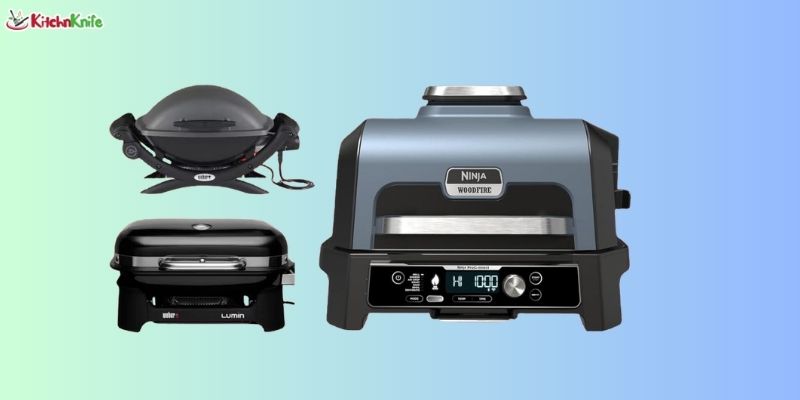
The Ninja Woodfire and similar premium smokeless models push toward the higher end of this range. At 240°C to 250°C you get noticeably better grill marks and faster cooking times than entry-level models.
Outdoor Electric BBQ Grill Models
Full-size outdoor electric BBQ grill units are the most powerful electric grilling option for home use.
Typical temperature range: 230°C to 290°C (445°F to 555°F)
Char Broil outdoor electric models and similar products operate at the higher end of what residential electric grills can achieve. At 260°C to 290°C you get results that approach mid-range gas grill performance.
These models are designed to sit on a patio or balcony with a direct power connection. They have larger heating elements and more surface area, which allows them to reach and maintain higher temperatures more effectively than compact indoor models.
Electric Griddle vs Electric Grill
This comparison comes up often. An electric griddle is a flat cooking surface. An electric grill has raised ridges that create grill marks.
Electric griddle temperature range: 150°C to 230°C (300°F to 445°F)
Electric griddles are designed for pancakes, eggs, bacon, and flat cooking tasks. They heat evenly across a large flat surface. They are not designed for the same high heat as a dedicated barbeque grill.
If you want grill marks and high-heat searing, use an electric BBQ grill, not an electric griddle. The designs serve very different purposes.
How Electric Grills Compare to Gas and Charcoal
Here is the direct comparison you are probably looking for.
Electric grill: 200°C to 290°C depending on model.
Gas grill: 230°C to 315°C at standard operation. Can exceed 370°C with all burners at maximum.
Charcoal grill: 260°C to 370°C during cooking. Can exceed 480°C directly above coals at peak.
Key takeaways:
A basic indoor grill or smokeless grill model runs noticeably cooler than a gas grill at full output. For casual everyday cooking this gap is manageable. For high-heat searing it matters.
A full-size outdoor electric BBQ grill closes the gap significantly. At 260°C to 290°C it performs similarly to a mid-range gas grill during normal cooking sessions.
A charcoal grill at peak output produces more heat than any home electric grill currently available. The intense radiant heat from glowing charcoal coals is simply more powerful than any residential electric heating element.
This is one of the practical reasons charcoal grilling produces different results from electric grilling. It is not just the smoke. It is also the higher peak temperature that creates a faster, more intense sear on the food surface.
What Electric Grill Temperatures Can and Cannot Do
Let me be practical about what these temperatures mean in your kitchen or on your balcony.
What electric grill temperatures handle well:
- Chicken breasts and thighs — Cook through safely and develop good browning at 220°C to 250°C
- Burgers — Sear and cook evenly with solid grill marks at 230°C and above
- Fish and salmon — Cook quickly and cleanly at 200°C to 220°C without drying out
- Vegetables — Roast and char effectively at 220°C to 240°C
- Pork chops — Cook through with good surface color at 230°C to 250°C
- Sausages — Cook thoroughly at medium to high electric grill settings
Where electric grill temperatures fall short:
- Steakhouse-level searing — A deep, thick crust on a ribeye benefits from 290°C or higher. Many electric grills struggle to sustain this during the initial sear.
- Very thick cuts of meat — Large bone-in cuts need sustained high heat and may take significantly longer on an electric grill than on a gas grill or charcoal grill.
- Whole chickens or large roasts — These are better suited to an oven or a larger outdoor gas grill with a lid that circulates heat.
How to Get Maximum Temperature From Your Electric Grill
Whatever electric grill you own, these steps help you extract every degree of heat from it.
Preheat for longer than you think you need.
Most manufacturers say eight to ten minutes. I preheat for twelve to fifteen minutes when I want maximum heat. The grates keep absorbing heat from the element during this extra time. This makes a real difference to searing performance.
Keep the lid closed during preheating.
If your electric BBQ grill has a lid, keep it closed during the entire preheat period. The trapped heat builds up much faster than in an open grill.
Use the highest setting during preheat.
Always preheat on the highest temperature setting. You can reduce heat once food is on the grill. But you want maximum temperature before you start.
Do not overcrowd the grill surface.
Adding too much food at once drops the grate temperature significantly. The heating element takes time to recover. Cook in batches if needed. Leave space between pieces of food.
Oil the food, not the grates.
Oiling food rather than grates improves heat transfer between the grate and the food surface. It also promotes better browning and reduces sticking.
Check that your power outlet delivers full current.
An electric BBQ grill connected to a power outlet through a long extension cord or a shared circuit may not receive full power. This reduces the maximum temperature the heating element can reach. Plug directly into a dedicated outlet whenever possible.
Does Temperature Affect Cleaning?
Yes. And it matters more than most people realize.
Grilling at proper high temperatures actually makes cleaning easier. Food and grease burn off the grate surface during cooking at high heat. The grates are cleaner after a properly hot cook than after cooking at low temperatures where fat sits and bakes slowly onto the surface.
This is why I always recommend full preheating before cooking. It is not just about food results. It also protects the grates and makes post-cook cleanup faster.
A Char Broil outdoor electric BBQ grill at full temperature leaves the grates much easier to brush clean than the same grill used at half power.
Temperature Tips for Specific Foods
Here is a quick reference guide I use for my own cooking sessions.
Steak: Preheat to maximum. Sear for two to three minutes per side on the hottest setting. Then reduce to medium to finish cooking to your target internal temperature.
Chicken breast: Cook at medium-high (around 220°C to 230°C). Cook for six to eight minutes per side. Always confirm 74°C internal temperature with a meat thermometer.
Salmon: Use medium heat around 200°C to 210°C. Cook for three to four minutes per side. Fish cooks quickly and dries out if overheated.
Burgers: High heat around 230°C to 250°C. Four to five minutes per side for medium doneness. Do not press down during cooking.
Vegetables: Medium to medium-high. Four to six minutes per side depending on thickness. Toss with oil and season well before grilling.
Sausages: Medium heat around 200°C to 220°C. Turn regularly for even browning. Cook until internal temperature reaches 70°C or above.
Frequently Asked Questions
How hot does a typical electric BBQ grill get at maximum setting? Most home electric BBQ grill models reach between 230°C and 260°C at maximum setting. Premium outdoor models from brands like Char Broil can reach closer to 290°C. Compact indoor grill and smokeless grill models typically top out around 220°C to 240°C. Always preheat for twelve to fifteen minutes to reach maximum grate temperature before cooking.
Is an electric grill hot enough to sear steak properly? Yes, though results vary by model. A full-size outdoor electric BBQ grill at maximum temperature produces a good sear on steak. Compact indoor grill models produce lighter searing. For the deepest possible steak crust, a charcoal grill or high-output gas grill at 300°C or above delivers better results. For everyday home cooking though, a properly preheated electric grill produces a solid sear.
How does an electric grill temperature compare to a gas grill? A gas grill at full output reaches 260°C to 315°C during normal cooking. Some gas grills exceed 370°C with all burners at maximum. A home electric grill reaches 200°C to 290°C depending on model and size. Large outdoor electric models approach gas grill performance. Compact indoor models run cooler. For high-heat tasks, gas grills have a temperature advantage over most electric models.