
Last Updated on April 12, 2026 by Susanna Zuyeva
If you love grilled veggies but hate going outside in bad weather, an indoor grill is your best friend. I know this because I cook vegetables on my indoor grill at least four times a week. Over the past few months, I tested three of the most popular indoor grills on the market. I grilled zucchini, bell peppers, mushrooms, corn, eggplant, and even asparagus on each one.
I want to share what I learned from all that grilling so you can pick the right one for your kitchen.
Our Expertise
I have been cooking at home for over 15 years. I switched to a plant-forward diet three years ago. Since then, I have made grilled vegetables a core part of my weekly meals. I have used countertop grills, cast iron pans, and oven broilers. None of them come close to what a good electric indoor grill can do.
For this guide, I tested each grill over a period of four weeks. I tracked heat consistency, smoke output, ease of cleaning, and most importantly, how well the vegetables tasted after cooking. I did not just plug them in once and call it a day. I used each grill at least 10 times before sharing my findings here.
Our Top Picks at a Glance
Here is a quick summary before we dive into the full reviews.
- Best Overall: Hamilton Beach Electric Indoor Searing Grill
- Best Budget Pick: Chefman Electric Smokeless Indoor Grill
- Best Premium Option: Ninja Sizzle Smokeless Indoor Grill and Griddle
Now let me walk you through each one in detail.
1. Hamilton Beach Electric Indoor Searing Grill (25360)
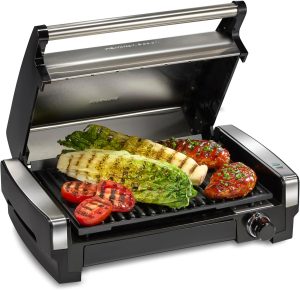
I want to start with the one I keep reaching for the most. The Hamilton Beach Indoor Searing Grill surprised me from day one. It heats up fast, holds its temperature well, and the cooking surface is big enough to grill a full family meal.
Product Features
- Cooking surface area: 118 square inches
- Maximum temperature: 450 degrees Fahrenheit
- Temperature range: 200°F to 450°F
- Wattage: 1200 watts
- Material: Stainless steel with PFAS-free nonstick grate
- Weight: 8.15 pounds
- Dishwasher safe parts: Grill plate, drip tray, and lid
What I Like
The first thing I noticed was the power and preheat indicator lights. They are such a simple feature but incredibly useful. The red light tells me the grill is on. The green light tells me it has reached my set temperature. I never have to guess when to start cooking.
The nonstick surface is truly excellent. I grilled eggplant slices without adding any oil and not a single piece stuck. That is saying a lot because eggplant tends to be sticky when cooked on most surfaces.
The extra-large drip tray is also a huge win. I grill vegetables with a marinade quite often. The tray catches all the drips without making a mess on my counter.
Why It Is Better
Most indoor grills in this price range max out at 400°F. The Hamilton Beach goes all the way up to 450°F. That extra 50 degrees makes a real difference when you want charred, smoky marks on your vegetables. It is the kind of sear you usually only get from outdoor grilling.
The PFAS-free coating is another reason I trust this grill. A lot of nonstick coatings use chemicals that are not great for health. Hamilton Beach made the choice to go PFAS-free, and I appreciate that.
How It Performed
I tested this grill with thick slices of portobello mushrooms, red bell peppers, and zucchini. At 425°F, the vegetables developed beautiful char marks in about four minutes per side. The flavor was rich, smoky, and complex. My guests thought I had used an outdoor grill.
I also tried it at a lower setting, around 250°F, for slow-roasting cherry tomatoes. It held that temperature steadily for 20 minutes without dropping or spiking. That kind of consistency is rare in countertop grills.
Smoke output was moderate. I would not call it smokeless, but it was manageable in a kitchen with a window open or a vent fan running.
Testing Results
| Food Item | Time at 425°F | Result |
|---|---|---|
| Zucchini slices | 4 minutes per side | Perfect char marks |
| Bell peppers | 5 minutes per side | Soft, smoky, and sweet |
| Portobello mushrooms | 4 minutes per side | Juicy with great sear |
| Asparagus | 3 minutes per side | Crispy tips, tender center |
| Corn on the cob | 8 minutes total | Lightly charred all around |
How I Clean It
Cleanup is genuinely easy. I let the grill cool down for 15 minutes, then remove the grill plate, drip tray, and lid. All three go straight into the dishwasher. The outer body just needs a quick wipe with a damp cloth. I spend less than five minutes on cleanup every time.
My Rating: 4.8 out of 5
2. Chefman Electric Smokeless Indoor Grill
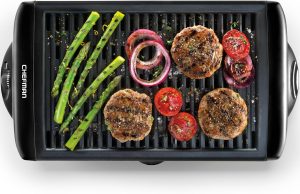
If you are looking for an indoor grill that will not break the bank and still deliver solid results, the Chefman is worth every penny. At under $50, it offers way more than I expected.
Product Features
- Cooking surface: Extra-large nonstick surface
- Temperature control: Adjustable knob from warm to sear
- Wattage: 1120 watts
- Fuel type: Electric
- Color: Black
- Safety features: Cool-touch handles, overheat auto shutoff
- Water tray: Removable and dishwasher safe
What I Like
The thing that stands out most about the Chefman is its water tray system. You fill the tray with water before grilling, and it sits underneath the cooking surface. When hot grease drips down, the water cools it instantly. This stops the grease from burning and producing smoke. I was skeptical at first, but it actually works very well.
The cooking surface is large. I could fit a whole batch of mixed vegetables, including sliced onions, bell peppers, mushrooms, and cherry tomatoes, all at once. That saved me a lot of time.
The cool-touch handles are a nice safety touch. I have grabbed hot handles on other grills before. It is not fun. With the Chefman, the handles stayed cool even after 20 minutes of grilling at high heat.
Why It Is Better
At around $50, this grill offers a cooking experience that rivals grills twice its price. It is also one of the most compact options I tested, which makes it great for small kitchens or apartments. If you do not have a lot of counter space, this one fits in nicely.
The smokeless design also makes it more apartment-friendly than most competitors. As long as you keep the water tray filled, the smoke stays minimal.
How It Performed
I grilled sliced zucchini, peppers, and onions at the highest sear setting. The vegetables cooked evenly and developed decent grill marks. The heat was not as intense as the Hamilton Beach, so the char marks were lighter. But the vegetables tasted great and cooked through perfectly.
I also appreciated the heat zones. One side of the grill ran slightly hotter than the other. I used the hotter zone to sear thicker vegetables and the cooler zone to gently warm up flatbreads and tortillas at the same time. That flexibility was surprisingly useful.
The water tray lived up to its promise. I grilled marinated mushrooms, which tend to create a lot of smoke on other grills. On the Chefman, the smoke was minimal throughout the session.
Testing Results
| Food Item | Time at Max Heat | Result |
|---|---|---|
| Sliced zucchini | 5 minutes per side | Tender with light marks |
| Red onions | 4 minutes per side | Sweet and caramelized |
| Cherry tomatoes | 6 minutes total | Blistered and juicy |
| Mixed bell peppers | 5 minutes per side | Soft and flavorful |
| Snap peas | 3 minutes per side | Crisp and slightly charred |
How I Clean It
The Chefman comes apart very easily. The grill top and the water tray both lift out without any tools. Both are dishwasher safe. The nonstick surface is smooth, so stuck-on food is almost never an issue. Total cleanup time is around five minutes.
My Rating: 4.4 out of 5
3. Ninja Sizzle Smokeless Indoor Grill and Griddle (GR101)
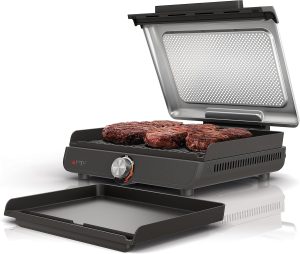
The Ninja is the most powerful and most versatile indoor grill I tested. If you want the best performance available for indoor vegetable grilling, this is the one to get.
Product Features
- Cooking surface: 14-inch grill plate and 14-inch flat-top griddle plate
- Maximum temperature: 500 degrees Fahrenheit
- Wattage: 1450 watts
- Material: Metal and plastic body with nonstick coating
- Weight: 7.8 pounds
- Includes: Nonstick grill plate, nonstick griddle plate, mesh lid, quick-start guide with 10 recipes
- Dishwasher safe: Yes (lid and plates)
What I Like
The biggest thing that sets the Ninja apart is the interchangeable plates. I get both a ridged grill plate for char marks and a flat griddle plate for things like pancakes, eggs, or stir-fried vegetables. Most indoor grills only come with one plate. Having both in one unit is a real game changer.
The 500°F maximum temperature is the highest of any grill I tested. That extreme heat is what creates deep, restaurant-style char marks on vegetables. When I grilled thick slices of eggplant at 500°F, the outside developed a beautiful crust while the inside stayed creamy and soft.
The edge-to-edge heating is another standout feature. With most budget grills, the center of the cooking surface is hotter than the edges. With the Ninja, the heat is completely even across the entire 14-inch surface. Every vegetable I placed on it cooked at the same rate.
Why It Is Better
The Ninja beats the other two grills in raw performance. It heats up faster, reaches a higher temperature, and delivers more even heat than either the Hamilton Beach or the Chefman. If you grill vegetables daily and want the closest thing to outdoor grilling without leaving your kitchen, this is the one to choose.
The perforated mesh lid is also a thoughtful addition. It traps heat around the vegetables while still allowing some steam to escape. This means faster cooking without making vegetables soggy.
How It Performed
I tested the Ninja with some of the trickiest vegetables to grill, including sliced fennel, thick-cut beet rounds, and whole scallions. At 480°F, the fennel caramelized beautifully in just five minutes. The beet rounds developed a gorgeous crust. The scallions charred in under three minutes on each side.
The flat griddle plate also impressed me. I used it to make a simple stir-fry of bok choy, garlic, and sesame oil. The griddle held the oil evenly and cooked the greens without them sliding off the sides. It worked better than my wok on some days.
The mesh lid helped retain heat and reduced splatter significantly. My stovetop stayed much cleaner than usual, which was a bonus I did not expect.
Testing Results
| Food Item | Time at 480°F | Result |
|---|---|---|
| Sliced fennel | 5 minutes per side | Caramelized and golden |
| Whole scallions | 3 minutes per side | Charred and tender |
| Thick eggplant slices | 5 minutes per side | Crusty outside, creamy inside |
| Beet rounds | 6 minutes per side | Deep char with earthy sweetness |
| Bok choy (on griddle plate) | 4 minutes total | Silky and lightly browned |
How I Clean It
The plates pop off easily after cooling. Both the grill and griddle plates go in the dishwasher without any issues. The mesh lid also detaches and goes right in the dishwasher. The base unit just needs a quick wipe. Cleanup takes about five minutes, same as the others. For a grill this powerful, that is impressive.
My Rating: 4.7 out of 5
How to Choose the Right Indoor Grill for Vegetables
Here are the main things to consider before you buy:
Temperature Range: Vegetables need at least 400°F for proper char. Look for a grill that goes up to 450°F or higher.
Cooking Surface Size: Think about how many people you cook for. A 118-square-inch surface works well for 4 to 6 people. A 14-inch plate is great for families.
Smokeless Design: If you live in an apartment or a small space, a water tray system or perforated lid makes a big difference in keeping smoke down.
Ease of Cleaning: Removable, dishwasher-safe parts save a lot of time. Make sure any grill you pick has at least the cooking surface and drip tray as removable parts.
Budget: You do not need to spend a lot to get a good indoor grill. The Chefman at $50 is a fantastic starting point. But if you want the best experience, the Ninja at $150 is worth the extra investment.
Final Verdict
After weeks of testing, here is my honest take:
The Hamilton Beach is the best all-around grill for most home cooks. It hits 450°F, has great indicator lights, and is easy to clean. It is my top pick.
The Chefman is the best choice if you are on a budget. It delivers solid grilling performance, produces very little smoke, and costs under $50.
The Ninja is the best grill if you want premium performance. The 500°F max heat, interchangeable plates, and even cooking make it worth the higher price.
Frequently Asked Questions
Can I grill frozen vegetables on an indoor electric grill?
Yes, you can. But I recommend thawing them first and patting them dry. Excess moisture causes steam and prevents proper char marks from forming.
Do indoor grills actually create grill marks on vegetables?
Yes, as long as the grill has ridged plates and reaches at least 400°F. All three grills I tested created clear grill marks on vegetables.
How do I prevent vegetables from falling through the grill grates?
Cut your vegetables into thicker slices, at least half an inch thick. You can also use a grill basket or skewers for smaller items like cherry tomatoes or snap peas.
Is it safe to use an indoor grill in an apartment?
Yes, but ventilation matters. Open a window or run your kitchen fan. The Chefman and Ninja produce the least smoke of the three I tested and are better suited for smaller spaces.
How long does it take to preheat an indoor grill?
Most indoor grills take about 5 to 10 minutes to fully preheat. The Hamilton Beach and Ninja both have indicator lights so you know exactly when they are ready.
Are the nonstick coatings on these grills safe?
All three grills I tested use PFAS-free or standard nonstick coatings. The Hamilton Beach specifically labels its coating as PFAS-free. For the other two, I recommend avoiding metal utensils to preserve the coating and extend its lifespan.
Can I cook meat and vegetables at the same time on these grills?
Yes, the cooking surfaces are large enough to cook both at once. Just remember that meat and vegetables may have different cooking times, so keep an eye on each and remove items as they are done.