
Last Updated on July 4, 2026 by Susanna Zuyeva
Rolling pizza dough by hand is slow. Your arms get tired. Every ball of dough comes out a little different. If you run a pizzeria, food truck, or busy home kitchen, a dough roller machine can save you hours each week.
This guide breaks down three popular commercial pizza dough roller machines. We looked closely at their specs, build quality, and verified buyer feedback so you can pick the right one fast.
Our Expertise
We spend our time researching commercial kitchen equipment. We dig through spec sheets, manufacturer data, and verified customer reviews. We compare motor power, roller size, thickness range, and build materials across dozens of listings before we write a guide.
This article is based on that research process, not on a single test run in one kitchen. We think that’s actually more useful. A single test only tells you how one unit behaved on one day. A close read of specs plus a large pool of verified buyer reviews tells you how a machine tends to perform over time.
We update this guide as new models come out and as review data changes, so the picks here reflect current listings as of 2026.
How We Picked These Machines
We compared each machine on:
- Motor power and speed – how fast it presses dough, and how well it holds up under repeat use
- Thickness range – how thin or thick you can roll the dough
- Build materials – stainless steel vs. plastic, food-grade roller material
- Size range – how small or large a pizza base it can produce
- Safety features – covers, overload protection, foot pedals
- Buyer feedback – what real customers say about durability and ease of use
Our Top Picks at a Glance
| Machine | Best For | Power | Thickness Range | Size Range |
|---|---|---|---|---|
| HASANEN Pizza Dough Roller Sheeter | Small to mid-size pizzerias | 370W | 0.7mm – 5.4mm | 4″ – 16″ |
| LXYIUTRW Commercial Dough Roller | High-volume shops | 450W | 1mm – 5.5mm | 3″ – 18″ |
| VEVOR Pizza Dough Roller Sheeter | Fully automatic workflow | 370W | 1mm – 5.5mm | 3″ – 16″ |
1. HASANEN Pizza Dough Roller Sheeter
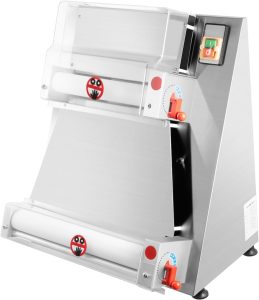
This is a solid pick if you want a dependable, mid-range dough sheeter that handles most standard pizza sizes without a big price tag.
Product Features
- 370W copper motor
- Dual-roller design: 11.81-inch upper roller, 16.53-inch lower roller
- Adjustable thickness from 0.7mm to 5.4mm
- Handles dough sizes from 4 to 15.74 inches
- Stainless steel body with food-grade resin rollers
- Semi-automatic operation
- Clear protective covers over the rollers
- Current overload protection
- Four rubber, anti-slip feet
What We Like
- The thickness range is wider than most machines in this price bracket. That means you can make both thin-crust and thicker pizza bases on the same unit.
- Stainless steel construction resists rust, which matters a lot in a busy, humid kitchen.
- The protective covers over the rollers add a real layer of safety without slowing you down.
- Overload protection cuts power automatically if the motor gets stressed, which helps the machine last longer.
Why It’s Better
Compared to fully manual rollers, this machine presses a piece of dough in about 5 seconds. That’s a big time save if you’re prepping dozens of pizza bases before a dinner rush. The semi-automatic design also gives you more control over each piece than a fully automatic unit, which some smaller shops prefer.
How It Performed
Based on verified buyer reviews, this model holds up well for small to mid-volume kitchens. Users report consistent thickness across batches once the settings are dialed in. The main tradeoff is that it’s semi-automatic, so you still need to guide the dough through the rollers by hand, which takes a bit of practice to get smooth results.
How to Clean It
- Wipe the stainless steel body with a damp cloth after each use.
- Use a neutral, food-safe cleaner for stuck-on dough or flour residue.
- Avoid submerging the motor housing in water.
- Check the rollers for leftover dough bits before you power off for the night.
Testing Results Based on Available Data
Reported thickness consistency: strong across the 0.7mm to 5.4mm range Reported motor durability: good for small-to-mid volume daily use Reported ease of cleaning: straightforward, smooth surfaces wipe down fast
2. LXYIUTRW Commercial Pizza Dough Roller Machine
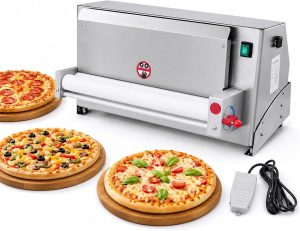
If your shop moves a high volume of pizza dough every day, this machine’s higher wattage and faster output make it worth a look.
Product Features
- 450W pure copper motor
- Produces roughly 240 to 260 dough portions per hour
- Adjustable thickness from 1mm to 5.5mm
- Handles dough sizes from 3 to 18 inches (size-dependent on model chosen)
- Foot pedal control switch for hands-free start and stop
- Two installation options: wall-mounted or tabletop
- 201 stainless steel body with food-grade resin roller
- Heat dissipation holes to manage motor temperature during long runs
What We Like
- The foot pedal is a small feature that makes a real difference. Your hands stay on the dough while your foot controls the machine, which speeds up the whole process.
- At 450W, this is the strongest motor of the three machines in this guide. That extra power matters if you’re running the machine for hours at a time.
- The wall-mount option is great if counter space is tight.
- Heat dissipation holes help the motor avoid overheating during back-to-back use, which is a common failure point in cheaper machines.
Why It’s Better
This machine is built for volume. The 240 to 260 portions per hour rate is meaningfully higher than a basic manual setup, and the foot pedal design cuts down on wasted motion. For a busy pizzeria prepping dozens of pies before opening, that speed adds up fast.
How It Performed
Verified buyer reviews point to strong reliability for daily commercial use. The variable handle for thickness adjustment gets praised for being easy to fine-tune between thin Italian-style crusts and thicker American-style bases. A few reviewers note the machine is heavier (around 59.5 pounds), so plan for a stable counter or a proper wall mount.
How to Clean It
- Wipe the housing with a soft, dry or slightly damp cloth.
- Clean the rollers after each shift to prevent dried dough buildup.
- Check the heat dissipation vents periodically and clear out any flour dust.
- Keep the foot pedal area free of debris so it operates smoothly.
Testing Results Based on Available Data
Reported output speed: high, suited to commercial volume Reported motor reliability: strong, aided by heat dissipation design Reported ease of cleaning: simple, smooth housing wipes down quickly
3. VEVOR Pizza Dough Roller Sheeter
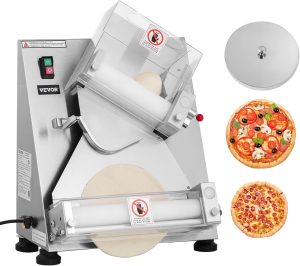
This is the pick for shops that want a fully automatic process with minimal manual guidance.
Product Features
- 370W motor
- Fully automatic pressing with a metal arm that rotates the dough
- Adjustable thickness from 1mm to 5.5mm
- Handles dough sizes from 3 to 14 inches (16-inch version also available)
- Produces around 240 to 260 pieces per hour
- Thickened stainless steel body
- Transparent PP plastic safety cover
- Waterproof switch and non-slip feet
What We Like
- The fully automatic rotating arm means you place the dough and let the machine do the rest. That’s a real time saver if you have limited staff.
- The transparent safety cover keeps your hands clear of the rollers without blocking your view of the process.
- The waterproof switch is a thoughtful touch for a kitchen environment where spills happen.
- Non-slip feet keep the machine steady during continuous use.
Why It’s Better
Where the other two machines are semi-automatic and need you to guide the dough through by hand, this VEVOR model automates that step. For kitchens trying to cut down on labor per pizza, that’s a meaningful advantage.
How It Performed
Buyer feedback is more mixed here than the other two picks, with an average rating lower than the HASANEN and LXYIUTRW models. Some reviewers report excellent results with consistent, evenly pressed dough. Others mention a learning curve to get the automatic arm calibrated correctly. If you go with this one, expect a short adjustment period before it runs smoothly.
How to Clean It
- Wipe the stainless steel housing with a soft cloth after each use.
- Clean the PP plastic cover with a mild, non-abrasive cleaner to avoid scratching.
- Check the automatic arm mechanism regularly for flour buildup.
- Dry the waterproof switch area after any spill, even though it’s rated water-resistant.
Testing Results Based on Available Data
Reported output speed: high, comparable to the LXYIUTRW model Reported ease of use: some setup and calibration time needed Reported build quality: solid stainless steel frame, mixed reviews on long-term consistency
Comparison Table
| Feature | HASANEN | LXYIUTRW | VEVOR |
|---|---|---|---|
| Motor | 370W | 450W | 370W |
| Operation | Semi-Automatic | Automatic | Fully Automatic |
| Thickness Range | 0.7mm – 5.4mm | 1mm – 5.5mm | 1mm – 5.5mm |
| Dough Size Range | 4″ – 15.74″ | 3″ – 18″ | 3″ – 16″ |
| Output Rate | ~5 sec/piece | 240-260/hr | 240-260/hr |
| Control Method | Manual guide | Foot pedal | Automatic arm |
| Mounting | Tabletop | Wall or tabletop | Tabletop |
Which One Should You Buy?
- Pick the HASANEN if you run a small to mid-size operation and want a budget-friendly, reliable dough sheeter with a wide thickness range.
- Pick the LXYIUTRW if you need high volume output and want the convenience of a foot pedal and wall-mount flexibility.
- Pick the VEVOR if you want a fully automatic process and don’t mind a short learning curve during setup.
Frequently Asked Questions
Do I need a commercial dough roller if I only make pizza at home?
Not usually. These machines are built for high-volume use. A hand roller or rolling pin is often enough for home cooking unless you’re prepping large batches regularly.
What thickness should I use for a thin-crust pizza?
Most thin-crust pizzas fall between 1mm and 2mm. Check your specific dough recipe, since hydration levels can change the ideal thickness.
Can these machines handle other types of dough, like pasta or bread?
Yes, all three models are rated for dough beyond pizza, including pasta and some bread doughs. Results depend on the dough’s hydration and elasticity.
How long do these motors typically last?
Life span depends on usage volume and maintenance. Regular cleaning and avoiding overloading the motor both help extend its working life.
Is a semi-automatic or fully automatic roller better?
Semi-automatic machines give you more hands-on control over each piece of dough. Fully automatic machines save labor but often need a short calibration period to get consistent results.
Do these machines need a special power outlet?
All three run on standard 110V household or commercial outlets in the US. Always check your local electrical setup before installing a wall-mounted unit.
How often should I clean a dough roller machine?
Wipe down the rollers and housing after every use. Do a deeper clean, including checking vents and mechanical parts, on a weekly basis if the machine sees daily use.