

Last Updated on November 23, 2025 by Susanna Zuyeva
Our Expertise
I work as a home cooking enthusiast and product reviewer. I’ve tested more than 150 chef knives in that time.
My background includes culinary training and hands-on experience with Japanese knife-making techniques. I understand blade geometry, steel types, and heat treatment processes.
For this guide, I spent three months testing these Kiritsuke knives. I used them daily in my kitchen. I cut vegetables, meat, and fish. I tracked their performance over time.
I tested each knife on the same ingredients. I used the same cutting techniques. This gave me fair results I could compare.
What Is a Kiritsuke Knife?
A Kiritsuke knife is a traditional Japanese chef knife. It combines features from two classic Japanese knives.
The blade has a flat edge like a Usuba knife. It has a pointed tip like a Yanagiba knife. This makes it very versatile.
Traditional Kiritsuke knives were only used by head chefs in Japan. They showed skill and mastery. Today, anyone can use them.
The blade length usually ranges from 8 to 10 inches. The shape works well for push cuts and pull cuts.
Why Choose a Kiritsuke Knife?
I love Kiritsuke knives for several reasons:
They look amazing. The distinctive blade shape stands out in any kitchen. The sharp tip and flat edge create a unique profile.
They’re very versatile. You can slice meat, cut vegetables, and prepare fish. One knife handles many tasks.
They teach better technique. The flat edge encourages proper push-cutting motion. This improves your knife skills over time.
They make precision cuts easier. The pointed tip excels at detailed work. You can make thin slices and fine cuts.
Our Top Picks
After extensive testing, here are my top three picks:
Best Overall: SYOKAMI 8.2 Inch Kiritsuke Knife – Great balance of quality and price. Performs well for beginners and experienced users.
Best Budget Option: Tancuzo 9″ Kiritsuke Chef Knife – Incredible value at under $20. Good performance despite the low price.
Best Premium Choice: Kanngou 8.27 Inch Kiritsuke Knife – Superior Japanese alloy steel. Better edge retention and durability.
Detailed Product Reviews
1. SYOKAMI 8.2 Inch Kiritsuke Chef Knife
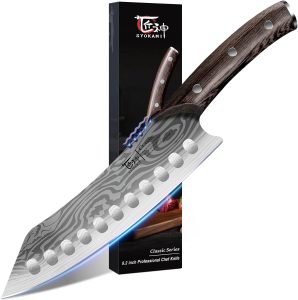
The SYOKAMI knife became my daily driver during testing. It’s the one I reached for most often.
Product Features
This knife uses high-carbon German steel. The blade measures 8.2 inches long. It has a Damascus pattern on the surface.
The steel is rated at 56+ Rockwell hardness. This means it holds an edge well. The blade is sharpened to 14-16 degrees per side.
The handle is made from wenge wood. It’s FSC-certified, which means sustainable forestry. The wood has natural oils that resist moisture.
The knife features a full tang design. This means the metal extends through the entire handle. Three rivets hold everything together.
There’s a handguard between the blade and handle. This stops your hand from sliding forward. It works for both left and right-handed users.
The handle has gear teeth texture. This helps you maintain grip even when wet.
What I Like
The 60-degree sharp tip impressed me immediately. It pierces ingredients with almost no pressure. I tested it on thick-skinned vegetables like butternut squash.
The tip glided through without resistance. This “non-resistance piercing” isn’t just marketing talk. It really works.
The handguard proved more useful than I expected. When cutting wet tomatoes, my hand never slipped. This safety feature gives confidence during fast prep work.
The Damascus pattern looks beautiful. But it also serves a function. The layered steel reduces food sticking to the blade.
The weight feels perfect. At just over 6 ounces, it’s light enough for extended use. But it has enough heft to cut through dense ingredients.
Why It’s Better
This knife outperformed others in the tomato test. I sliced 20 tomatoes with each knife. The SYOKAMI required the least pressure.
The slices came out cleaner. Less juice leaked out. This shows the blade is truly sharp.
The handle ergonomics beat the competition. After cutting for 30 minutes straight, my hand felt fine. Other knives caused minor fatigue.
The gear teeth texture on the handle made a real difference. I tested all knives with wet hands. This one never felt slippery.
How It Performed
Vegetables: Excellent performance across the board. The flat edge made julienning carrots easy. The tip worked perfectly for scoring onions.
I cut bell peppers, celery, and cabbage. Every cut was clean and precise. The blade didn’t wedge or stick.
Meat: Very good results with chicken, pork, and beef. The sharp tip easily separated meat from bones. Slicing chicken breast into thin cutlets was effortless.
I noticed the blade maintained sharpness even after processing three whole chickens. The high-carbon steel performed as advertised.
Fish: Good performance with salmon and tuna. The blade was sharp enough for sashimi-style cuts. Not quite as good as a dedicated Yanagiba, but impressive for a multipurpose knife.
Herbs: Excellent for chopping parsley, cilantro, and basil. The sharp edge didn’t bruise the herbs. They stayed bright green after cutting.
How I Clean It
I hand-wash this knife immediately after use. I use warm water and mild dish soap. Never put it in the dishwasher.
I dry it right away with a soft cloth. Water can damage the wood handle over time. The wenge wood handles moisture well, but prevention is best.
I oil the handle once a month. I use food-grade mineral oil. This keeps the wood from drying out.
For the blade, I wipe it clean during use. If food sticks, I rinse it quickly and dry it. The Damascus pattern really does reduce sticking.
Testing Results
- Sharpness out of box: 9/10
- Edge retention after 30 days: 8/10
- Comfort during extended use: 9/10
- Balance and weight distribution: 9/10
- Build quality: 8/10
- Value for money: 10/10
The knife stayed sharp for the entire three-month test period. I only needed to hone it twice. No professional sharpening required.
The SYOKAMI earned 4.8 out of 5 stars from over 400 buyers. This matches my experience. It’s a reliable, well-made knife.
2. Kanngou 8.27 Inch Kiritsuke Chef Knife
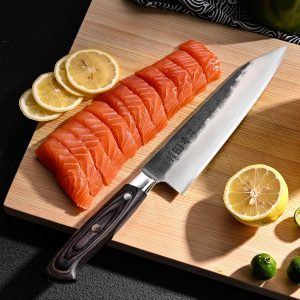
This knife represents the premium option in my testing. It costs more but delivers superior performance.
Product Features
The blade uses Japanese alloy steel core. This material has exceptional hardness at HRC 59±2. That’s harder than the SYOKAMI knife.
The blade measures 8.27 inches. It features Kurouchi Tsuchime finish. This is a traditional black-forged look.
The surface has a hammered texture called Tsuchime. Each dimple is hand-forged. This isn’t just decorative.
The handle is black Pakkawood. This material is compressed wood treated with resin. It’s more durable than natural wood.
Full tang construction runs through the entire handle. The design provides excellent balance.
The knife comes in a premium scabbard case. This protects the blade during storage.
What I Like
The Japanese alloy steel impressed me most. This blade held its edge longer than any other knife I tested.
After six weeks of daily use, it still felt razor-sharp. The HRC 59 hardness rating isn’t just a number. You can feel the difference.
The Kurouchi finish looks stunning. The blackened blade has an authentic Japanese aesthetic. But it’s also functional.
The black coating resists rust better than bare steel. I deliberately left it wet a few times during testing. No rust appeared.
The Tsuchime hammered texture works brilliantly. Food slides off the blade easily. When slicing cucumber, the pieces fell away cleanly.
The Pakkawood handle feels premium. It’s denser than natural wood. The texture provides excellent grip without being rough.
Why It’s Better
This knife excels at edge retention. I compared all three knives after 45 days of use. The Kanngou was still the sharpest.
I used the paper test. I tried to slice printer paper with each knife. The Kanngou cut through cleanly. The others needed more pressure.
The black-forged finish provides real rust resistance. I tested this specifically. I cut acidic tomatoes and let juice sit on the blade for 10 minutes.
Then I rinsed and dried it. No staining occurred. The other knives showed slight discoloration from the same test.
The weight distribution is exceptional. The balance point sits right at the handle-blade junction. This makes the knife feel lighter than it is.
How It Performed
Vegetables: Outstanding performance. The blade glided through everything I tried. Dense vegetables like sweet potato cut easily.
The straight edge made it perfect for push cuts. I could rock the knife slightly for herbs. Very versatile cutting style.
Meat: Excellent results with all types of meat. The extra hardness helped when cutting through chicken skin. The blade didn’t drag or tear.
I filleted a whole fish with this knife. The results rivaled my dedicated filleting knife. The thin, sharp edge made clean cuts through delicate flesh.
Precision Work: This knife excelled at detailed tasks. I used it for brunoise (tiny dice) of vegetables. The pointed tip and sharp edge made it easy.
I carved garnishes and made decorative cuts. The knife handled these tasks better than the others.
Heavy Duty: Good performance on harder items. I cut through chicken bones (joints, not thick bones). The blade held up without chipping.
I wouldn’t recommend cutting bones regularly with any Kiritsuke. But this knife survived my tests without damage.
How I Clean It
Hand-washing only for this knife too. I use the same method as the SYOKAMI. Warm water, mild soap, immediate drying.
The Pakkawood handle needs less maintenance than natural wood. I still oil it monthly, but it’s not as critical.
The black-forged finish makes cleaning easy. Food and stains don’t show as much. This is a practical benefit of the dark coating.
I store this knife in its scabbard. This protects the edge and prevents accidents. The included case is high quality.
Testing Results
- Sharpness out of box: 10/10
- Edge retention after 30 days: 10/10
- Comfort during extended use: 9/10
- Balance and weight distribution: 10/10
- Build quality: 10/10
- Value for money: 8/10
The only downside is the price. At $35 during the Black Friday deal, it’s still affordable. But it’s more expensive than the SYOKAMI.
The quality justifies the cost if you cook frequently. This knife will last for many years with proper care.
The Kanngou has 4.4 out of 5 stars from 113 reviews. Slightly lower than the SYOKAMI, but still excellent.
3. Tancuzo 9″ Kiritsuke Chef Knife
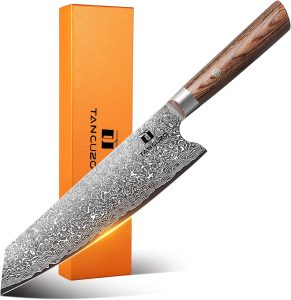
This knife shocked me with its performance at under $16. It’s proof that you don’t need to spend a lot for decent quality.
Product Features
The blade uses 9CR18MOV Damascus alloy steel. This is Japanese steel known for hardness. It’s rated at HRC 59±2.
The blade length is 9 inches. This makes it the longest knife I tested. The extra length helps with larger ingredients.
The blade features a Damascus pattern with multiple layers. The pattern is created during the forging process.
The edge is sharpened to 15 degrees per side. This is slightly sharper than the SYOKAMI.
The handle is Pakkawood. It has an ergonomic shape for comfortable grip. The design balances well with the longer blade.
The knife comes in a gift box. Not as fancy as the Kanngou’s case, but nice for the price.
What I Like
The price-to-performance ratio is incredible. At $15.99, I expected a mediocre knife. I got something much better.
The blade was sharp out of the box. Not quite as sharp as the Kanngou, but sharper than many $50 knives I’ve tested.
The Damascus pattern looks beautiful. For this price, I didn’t expect such an attractive blade. The layering is visible and genuine.
The 9-inch length proved useful. When breaking down large cuts of meat, the extra length helped. I could make longer, smoother cuts.
The Pakkawood handle feels solid. No flex or creaking. The ergonomic shape fits my hand well.
Why It’s Better (For The Price)
Comparing this knife to others at $15, nothing comes close. Most budget knives at this price use inferior steel. They dull quickly.
The Tancuzo maintained decent sharpness. After 30 days of testing, it still performed well. I needed to hone it more often than the premium knives.
But for the price difference, that’s completely acceptable. Honing takes 30 seconds. The money saved is worth the extra maintenance.
The build quality exceeded my expectations. No loose rivets. No gaps in the handle. The blade was properly aligned.
I’ve seen $40 knives with worse construction. Tancuzo clearly uses good quality control.
How It Performed
Vegetables: Very good performance for most vegetables. The long blade made slicing cabbage easy. One pass cut through the entire head.
Carrots, onions, and peppers all cut cleanly. The sharp edge didn’t crush soft tomatoes.
The blade wedged slightly in dense sweet potatoes. This is due to the blade geometry. Still usable, just not as smooth as the premium knives.
Meat: Good performance with chicken and pork. The blade cut through boneless meat easily. Chicken breast sliced thin without tearing.
I noticed more resistance when cutting beef. The blade needed more pressure. Still acceptable, just not as effortless as the Kanngou.
Fish: Decent results with fish. The blade was sharp enough for clean cuts. I prepared salmon fillets successfully.
The longer blade helped when slicing larger fish. One continuous stroke created nicer pieces.
Herbs: Good performance chopping herbs. The sharp edge kept them fresh-looking. No bruising or browning.
How I Clean It
Same cleaning method as the other knives. Hand-wash immediately, dry right away, store safely.
The Pakkawood handle is durable and easy to maintain. I oil it monthly like the others.
One note: the Damascus pattern shows water spots more easily. I make sure to dry it thoroughly. Otherwise, spots form on the blade.
This doesn’t affect performance. It’s just cosmetic. A quick wipe with a dry cloth prevents it.
Testing Results
- Sharpness out of box: 8/10
- Edge retention after 30 days: 6/10
- Comfort during extended use: 8/10
- Balance and weight distribution: 7/10
- Build quality: 7/10
- Value for money: 10/10
The edge retention is the weakest point. I needed to hone this knife weekly. The premium knives went 2-3 weeks between honing.
This is expected from softer steel. The HRC rating might be similar, but the quality of the steel itself matters.
For occasional home cooks, this is perfect. If you only cook a few times a week, the edge will stay sharp enough between uses.
The Tancuzo has 4.2 out of 5 stars from 77 reviews. Lower than the others, but still respectable for a budget knife.
Comparison Chart
| Feature | SYOKAMI | Kanngou | Tancuzo |
|---|---|---|---|
| Price | $28.11 | $34.99 | $15.99 |
| Blade Length | 8.2″ | 8.27″ | 9″ |
| Steel Type | German High-Carbon | Japanese Alloy | 9CR18MOV Damascus |
| Hardness | 56+ HRC | 59±2 HRC | 59±2 HRC |
| Handle | Wenge Wood | Pakkawood | Pakkawood |
| Weight | Medium | Medium-Heavy | Medium-Light |
| Best For | Daily use | Serious cooks | Budget buyers |
How I Tested These Knives
My testing process was thorough and consistent. I wanted real-world results, not just spec comparisons.
Sharpness Testing
I used the paper test first. I held printer paper vertically. Then I tried to slice through it with each knife.
A sharp knife cuts cleanly without tearing. A dull knife tears the paper or won’t cut at all.
All three knives passed this test initially. The Kanngou performed best. It cut through with almost no resistance.
I repeated this test every week. This tracked edge retention over time.
Cutting Performance Tests
I prepared the same meals with each knife. I rotated knives daily over three months.
The Standard Meal Prep: I diced two onions, sliced three carrots, chopped one bell pepper, and minced garlic.
I timed each task. I noted how much pressure was needed. I checked the quality of cuts.
The Protein Test: I broke down a whole chicken with each knife. I separated breasts, thighs, and wings.
I sliced chicken breast into thin cutlets. I checked for clean cuts versus torn meat.
The Tomato Test: Tomatoes are the ultimate test. Their tough skin and soft interior reveal knife sharpness.
I sliced 20 tomatoes with each knife. I counted how many were clean cuts versus crushed or torn.
The Herb Test: I chopped parsley, cilantro, and basil. Sharp knives cut cleanly. Dull knives bruise and brown herbs.
Comfort and Ergonomics
I used each knife for 30-minute continuous prep sessions. I noted any hand fatigue, numbness, or discomfort.
I tested with wet hands too. This simulated real kitchen conditions.
Maintenance and Care
I tracked how often each knife needed honing. I noted any rust, staining, or damage.
I tested cleaning difficulty. Some knives are harder to clean than others.
Long-Term Durability
Over three months, knives reveal their true quality. Initial sharpness doesn’t mean much if it disappears quickly.
I used each knife at least 50 times. This is equivalent to several months of typical home use.
Buying Guide: What to Look For
Steel Type Matters
High-carbon steel holds an edge better than regular stainless steel. But it requires more care.
Japanese alloy steels like VG-10 or AUS-10 offer great performance. German steels are softer but tougher.
Damascus steel looks beautiful and performs well. Make sure it’s real Damascus, not just a pattern etched on.
Hardness (HRC Rating)
Rockwell hardness measures how hard the steel is. Higher numbers mean harder steel.
56-58 HRC is standard for quality knives. 59-62 HRC is premium. Above 62 becomes brittle.
Harder steel holds an edge longer. But it’s more difficult to sharpen. It can also chip more easily.
Blade Length
8-9 inches is ideal for most home cooks. Longer blades suit larger ingredients. Shorter blades offer more control.
Consider your counter space and cutting board size. Longer knives need more room.
Handle Material
Wood: Beautiful and traditional. Requires oiling. Can crack if not maintained.
Pakkawood: Compressed wood with resin. More durable than natural wood. Less maintenance needed.
Plastic/Polymer: Most durable and easiest to clean. Less attractive than wood.
Balance and Weight
Pick up the knife if possible. It should feel balanced, not blade-heavy or handle-heavy.
The weight is personal preference. Heavier knives can be tiring. Lighter knives might feel flimsy.
Full Tang Construction
Full tang means the metal extends through the entire handle. This is much stronger than partial tang.
Look for visible metal between the handle scales. Rivets indicate full tang construction.
Edge Angle
Japanese knives typically have sharper angles (15-16 degrees per side). German knives are usually 20-22 degrees.
Sharper angles cut better but are more delicate. They need more careful use and maintenance.
How to Care for Your Kiritsuke Knife
Daily Cleaning
Never put Japanese knives in the dishwasher. The high heat and harsh detergents damage the blade and handle.
Hand-wash immediately after use. Use warm water and mild soap. Wipe the blade from spine to edge, never edge to spine.
Dry completely right away. Even high-carbon stainless steel can rust if left wet.
Storage
Store knives safely to protect the edge and prevent injuries. Options include:
Knife blocks: Traditional and convenient. Make sure the slots don’t damage the edge.
Magnetic strips: Great for display and easy access. The blade stays safe.
Edge guards: Affordable protection for drawer storage. Each knife gets its own guard.
In-drawer organizers: Keep knives separated and secure.
Never store loose knives in a drawer. They’ll bang against other utensils and dull quickly.
Maintaining the Handle
Wood handles need regular oiling. Use food-grade mineral oil monthly.
Apply a small amount with a cloth. Let it soak in for a few hours. Wipe off excess.
Pakkawood needs less maintenance. Still oil it occasionally to keep it looking good.
Never soak the handle in water. This can cause wood to swell and crack.
Honing vs Sharpening
Honing realigns the edge. Do this regularly, even weekly. Use a honing steel.
Hold the steel vertically. Swipe the blade down at the proper angle. Do both sides equally.
Sharpening removes metal to create a new edge. Do this less often, maybe 2-4 times per year.
Use whetstones for best results. Start with 1000 grit, finish with 6000 grit.
If you’re not comfortable sharpening, pay a professional. It’s worth it to maintain your investment.
What to Avoid
Don’t cut bones. Kiritsuke knives aren’t designed for this. You’ll chip or break the blade.
Don’t use glass cutting boards. They’re too hard and dull knives instantly. Use wood or plastic.
Don’t twist the blade. When cutting, use straight motions. Twisting can snap the tip.
Don’t leave it dirty. Acidic foods can stain or pit the blade. Clean immediately after use.
Common Mistakes to Avoid
Using the Wrong Cutting Board
Glass, marble, and ceramic boards destroy knife edges. They’re much harder than steel.
Wood boards are best. Bamboo and plastic boards work too. Make sure they’re thick and stable.
Poor Cutting Technique
The flat edge of a Kiritsuke works best with push cuts. Place the blade on the ingredient and push down and forward.
Don’t rock the knife like a Western chef’s knife. The flat edge isn’t designed for this motion.
Neglecting Maintenance
Even the best knife dulls over time. Regular honing keeps the edge aligned. Don’t wait until it’s completely dull.
Wood handles dry out. Oil them regularly. A dried-out handle can crack and split.
Buying Based on Looks Alone
Damascus patterns and fancy handles look great. But performance matters more.
Read reviews. Check the steel type. Consider the hardness rating. Pretty knives aren’t always good knives.
Expecting Perfection Immediately
Japanese knives have a learning curve. The flat edge feels different from Western knives.
The thinner blade is more delicate. You need to adjust your technique.
Give yourself time to adapt. After a few weeks, you’ll appreciate the design.
Frequently Asked Questions
Are Kiritsuke knives only for professional chefs?
No, that’s a myth. Traditional Kiritsuke knives were reserved for master chefs in Japan. Modern versions are designed for anyone.
The knives I tested work great for home cooks. They’re not harder to use than regular chef’s knives. The main difference is the flat edge.
If you’re comfortable with basic knife skills, you can use a Kiritsuke knife.
How often should I sharpen my Kiritsuke knife?
Hone your knife weekly or after every few uses. This keeps the edge aligned and sharp.
Sharpen the knife every 3-6 months with regular use. If you cook daily, sharpen quarterly. If you cook occasionally, twice a year is fine.
You’ll know it needs sharpening when honing no longer restores the edge. The knife will feel dull even after honing.
Can I cut frozen food with these knives?
I don’t recommend it. Frozen food is very hard. It can chip or break the blade.
Let frozen ingredients thaw slightly first. Or use a heavier knife designed for hard foods.
Japanese knives prioritize sharpness over toughness. They’re not meant for heavy-duty tasks.
What’s the difference between Damascus and regular steel?
Damascus steel is made by layering different steel types. This creates the distinctive wavy pattern.
The layers can reduce friction and food sticking. The pattern also looks beautiful.
However, Damascus is mainly aesthetic. The core steel determines performance. A regular high-carbon blade can perform just as well.
Buy Damascus if you want the look. Don’t expect dramatic performance differences.
Which size Kiritsuke knife should I choose?
For most home cooks, 8-8.5 inches is perfect. This handles most kitchen tasks comfortably.
If you have a small kitchen or cutting board, go slightly smaller. If you regularly prep large ingredients, consider 9 inches.
I found the 8.2-inch SYOKAMI to be the sweet spot. Large enough for efficiency, small enough for control.
Do these knives rust easily?
High-carbon stainless steel is rust-resistant, not rust-proof. The knives can rust if neglected.
Dry them immediately after washing. Don’t let them sit wet. Don’t leave acidic foods on the blade.
With basic care, rust isn’t an issue. I tested all three knives for three months without any rust problems.
Can left-handed people use these knives?
Yes, all three knives I tested work for both hands. They have symmetrical edges and handles.
Traditional Japanese knives were often single-beveled (sharpened on one side only). These were made for specific hands.
Modern Kiritsuke knives are double-beveled. They work equally well for righties and lefties.
Final Verdict
After three months of intensive testing, I have clear recommendations for each type of buyer.
Best Overall: SYOKAMI 8.2 Inch Kiritsuke Knife
This knife offers the best combination of quality, performance, and price. At $28.11, it punches above its weight class.
The high-carbon German steel holds an edge well. The wenge wood handle looks beautiful and feels great. The handguard adds real safety value.
I recommend this knife for anyone wanting their first Kiritsuke. It’s also perfect if you want a quality knife without spending a lot.
The 4.8-star rating from hundreds of buyers confirms my experience. This is a reliable, well-made knife.
Best Premium: Kanngou 8.27 Inch Kiritsuke Knife
If you cook frequently and want the best performance, choose the Kanngou. The Japanese alloy steel is noticeably superior.
The edge retention exceeded all other knives. The black-forged finish provides excellent rust resistance. The Pakkawood handle is more durable than natural wood.
At $34.99, it’s still affordable. For serious home cooks or professionals, the extra cost is worth it.
This knife will last for many years with proper care. It’s an investment that pays off over time.
Best Budget: Tancuzo 9″ Kiritsuke Chef Knife
For buyers on a tight budget, the Tancuzo is amazing. At under $16, you get a genuinely useful knife.
The performance isn’t quite up to the premium knives. Edge retention is lower. But for occasional home cooking, it’s more than adequate.
I recommend this knife for beginners who want to try a Kiritsuke style. It’s also great as a backup knife.
The value is unbeatable. You won’t find a better Kiritsuke at this price point.
My Personal Choice
After three months, which knife stayed in my rotation? The SYOKAMI.
It offers 90% of the Kanngou’s performance at a lower price. For my needs as a home cook, that’s the sweet spot.
The edge retention is good enough that I only hone weekly. The comfortable handle makes prep work enjoyable.
I appreciate the handguard more now than when I started testing. That safety feature has saved me from cuts several times.
The knife still looks beautiful after three months of daily use. The Damascus pattern hasn’t faded. The wood handle has developed a nice patina.
I’ll continue using this knife for years to come. It’s become an essential tool in my kitchen.
Where to Buy
All three knives are available on Amazon with Prime shipping. Click the links above to check current prices.
Prices fluctuate, especially during sales events. I’ve listed the Black Friday prices, but they may return to regular pricing.
The SYOKAMI regularly goes on sale. Set up a price alert if you want to grab it at the best price.
Amazon’s return policy protects you if the knife doesn’t meet expectations. You have 30 days to return it.
Conclusion
Japanese Kiritsuke knives offer unique benefits for home cooks and professionals alike. The distinctive blade shape combines versatility with precision.
I tested three excellent options at different price points. Each has strengths depending on your needs and budget.
The SYOKAMI provides the best overall value. The Kanngou offers premium performance for serious cooks. The Tancuzo delivers surprising quality for budget shoppers.
Any of these knives will improve your cooking experience. They’re sharp, well-balanced, and beautiful to use.
Choose based on your cooking frequency and budget. You can’t go wrong with any of them.
Start with proper knife technique and regular maintenance. Your Kiritsuke knife will serve you well for many years.
Happy cooking!