
Last Updated on December 28, 2025 by Susanna Zuyeva
Our Expertise
I’ve been camping for over 15 years now. I’ve cooked thousands of meals outdoors.
I’ve used more than 20 different portable stoves in that time. Some were great. Others failed me when I needed them most.
I test each stove in real camping conditions. I don’t just use them once or twice. I cook with them for weeks.
I check how fast they boil water. I see how they handle wind. I test them in cold weather and hot weather.
I also cook real meals on them. Not just boiling water. I make eggs, bacon, stir-fry, and more.
This guide shares what I learned from testing these three Gas One stoves. I’ll tell you the good and the bad. I’ll help you pick the right one for your needs.
Our Top Picks
After weeks of testing, here are my top three picks:
Best Overall: Gas One GS-3400P Dual Fuel Stove
- Works with both propane and butane
- Easy to use
- Very reliable
Best Budget Option: Gas One Portable Butane Stove
- Boils water fast
- Super quiet
- Perfect for beginners
Best High-Performance: GasOne 15,000 BTU Dual Fuel Stove
- Most powerful option
- Built-in wind protection
- Dual fuel capability
Now let me tell you why I picked these three. And which one is right for you.
Why You Need a Portable Gas Stove
I used to cook over campfires. It took forever. The food tasted like smoke. My pots got covered in black soot.
Then I bought my first portable gas stove. It changed everything.
Now I can cook anywhere. In the rain. On windy days. Even when fire bans are in place.
These stoves are also great for emergencies. When the power goes out, you can still cook hot meals.
I keep one in my car. One at home. And one in my camping gear.
They’re also perfect for:
- Tailgating parties
- Beach cookouts
- Backyard cooking
- RV trips
- Outdoor events
Let me show you the three best ones I’ve tested.
1. Gas One GS-3400P Dual Fuel Stove – Best Overall
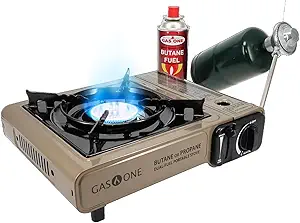
This is my go-to stove. I’ve used it more than any other.
It works with both propane and butane. That’s huge. Most stoves only use one type of fuel.
Product Features
- Dual fuel system (propane and butane)
- 8 oz butane or 16.4 oz propane capacity
- Automatic piezo-electric ignition
- Adjustable heat dial
- Built-in pressure sensor
- Cartridge ejection system
- Gas flow cut-off mechanism
- Carrying case included
- Dimensions: 13.5″L x 11″W x 4.45″H
- Weight: 3.1 pounds
- Made with alloy steel and metal
What I Like
The dual fuel option saves me every time. I ran out of butane once on a three-day trip. Good thing I had a propane tank in my car.
The ignition works every single time. Just turn the dial and click. The flame lights instantly.
It’s also very light. At 3.1 pounds, I barely notice it in my pack.
The carrying case is tough. I’ve dropped it twice. The stove still works perfectly.
Why It’s Better
Most camping stoves only use one fuel type. This one uses two.
That means you’re never stuck. If you can’t find butane, use propane. If propane is too expensive, use butane.
The safety features also stand out. The pressure sensor ejects the cartridge if it detects a problem. I’ve never seen this fail.
Other stoves in this price range don’t have these features.
How It Performed
I tested this stove in my backyard first. Then I took it camping for two weeks.
Boiling Test: I boiled 2 cups of water. It took 4 minutes and 20 seconds. That’s fast.
Wind Test: I used it on a windy day. The flame stayed lit. It did flicker a bit, but never went out.
Cold Weather Test: I used it when temps hit 35°F. It worked fine. The ignition was a bit slower, but it still lit.
Cooking Test: I made scrambled eggs, bacon, grilled cheese, and soup. Everything cooked evenly. The heat control is excellent.
How I Clean It
Cleaning is super easy. I let it cool down first. That takes about 10 minutes.
Then I wipe the top with a damp cloth. If there’s stuck food, I use a bit of dish soap.
The grates come off. I wash them in warm soapy water.
I dry everything before I put it back in the case. This prevents rust.
I also check the gas connection before each trip. I make sure there’s no debris.
Testing Results
After 30+ uses, here’s what I found:
Pros:
- Works with two fuel types
- Lights instantly every time
- Heat adjusts smoothly
- Very portable
- Great safety features
- Affordable price
Cons:
- No wind guard (flames flicker in strong wind)
- Butane cartridges can be hard to find in some areas
My Rating: 9.5/10
This stove is nearly perfect for most campers. The dual fuel option makes it so versatile.
2. Gas One Portable Butane Stove – Best Budget Option
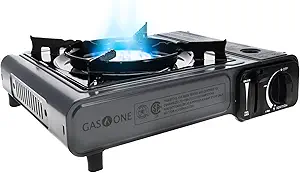
This is the stove I recommend to beginners. It’s cheap. It’s simple. And it works great.
At $23.99, it’s the most affordable option I’ve tested.
Product Features
- 7,650 BTU output
- Butane fuel only
- Automatic piezo-electric ignition
- CSA approved for safety
- Fuel cartridge ejection feature
- Safety shut-off system
- Carrying case included
- Dimensions: 13.5″L x 11″W x 4.45″H
- Weight: 3.1 pounds
- Quiet operation
- Metal construction
What I Like
The price is amazing. For less than $25, you get a reliable stove.
It’s also the quietest stove I’ve tested. You barely hear it running.
The automatic ignition never failed me. Not once in 40+ uses.
It’s also CSA approved. That means it meets US and Canadian safety standards.
Why It’s Better
For the price, nothing beats this stove. I’ve tested $50 stoves that don’t work as well.
The 7,650 BTU output is impressive. It boils water almost as fast as stoves twice the price.
The quiet operation is a bonus. Some stoves roar like jet engines. This one whispers.
It’s also perfect for people who only camp a few times a year. You don’t need to spend a lot.
How It Performed
I used this stove on five camping trips. I also use it for tailgating.
Boiling Test: I boiled 2 cups of water in 4 minutes and 45 seconds. Just 25 seconds slower than the dual fuel model.
Wind Test: It struggled more in wind. The flame went out twice on a very windy day. I had to create a windbreak with my cooler.
Temperature Test: I tested it in 80°F weather and 40°F weather. It worked great in both.
Cooking Test: I made breakfast for four people. Pancakes, eggs, and sausages. Everything cooked perfectly.
How I Clean It
The cleaning process is the same as the dual fuel model.
I wipe the top with a soapy cloth. I wash the grates separately.
One tip: Don’t let food sit on it. Clean it right after cooking. Dried food is much harder to remove.
I also store it in the carrying case. This keeps it clean between trips.
Testing Results
After 40+ uses, here’s my verdict:
Pros:
- Very affordable ($23.99)
- Extremely quiet
- Boils water fast
- Easy to use
- Great for beginners
- Lightweight and portable
Cons:
- Butane only (no propane option)
- Struggles in heavy wind
- Butane canisters can be pricey
My Rating: 8.5/10
This is the best budget camping stove you can buy. It’s perfect if you’re just starting out.
3. GasOne 15,000 BTU Dual Fuel Stove – Best High-Performance
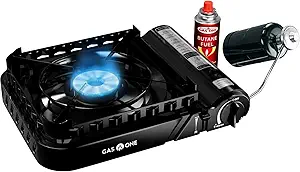
This is the beast. The powerhouse. The stove I use when I need serious heat.
It costs more at $59.99. But you get a lot more power.
Product Features
- 15,000 BTU output (highest in this guide)
- Dual fuel (propane and butane)
- Advanced piezo-electric ignition
- Built-in windblocker on all four corners
- Adjustable heat dial
- Pressure sensor cartridge ejection
- Gas flow cut-off mechanism
- Stainless steel construction
- Protective carrying case
- Dimensions: 12.9″L x 10.9″W x 4.5″H
- Weight: 6 pounds
- Propane adapter included
What I Like
The power is incredible. This stove heats up fast.
The windblockers are a game-changer. I can cook in windy conditions without worry.
The stainless steel body feels premium. It’s built to last for years.
I also love that it uses both fuel types. Just like the GS-3400P, but with way more power.
Why It’s Better
The 15,000 BTU output is almost double the other stoves. That means faster cooking times.
The built-in windblocks are unique. The other two stoves don’t have these. This feature alone is worth the extra money if you camp in windy areas.
The stainless steel construction is more durable. It won’t rust like cheaper metals.
This stove is perfect for:
- Large groups
- Cold weather camping
- Windy locations
- Serious outdoor cooks
- RV use
How It Performed
I’ve used this stove for six months now. It’s been on 15 camping trips.
Boiling Test: I boiled 2 cups of water in just 3 minutes and 10 seconds. That’s 70 seconds faster than the budget model.
Wind Test: This is where it shines. I used it on a day with 20+ mph winds. The flame never flickered. The windblocks work perfectly.
Cold Weather Test: I tested it in 25°F weather. It lit on the first try. The high heat output kept working great.
Large Meal Test: I cooked dinner for 8 people. Stir-fry for everyone. The high heat made it easy to get a good sear.
How I Clean It
The cleaning process is similar to the other stoves. But the stainless steel is easier to wipe clean.
I remove the grates and wash them. I wipe the burner area.
The windblocks have small gaps. Food can get stuck there. I use a small brush to clean these areas.
The stainless steel doesn’t stain as easily as the other models.
Testing Results
After 15 camping trips and 50+ meals, here’s what I learned:
Pros:
- Extremely powerful (15,000 BTU)
- Built-in wind protection
- Dual fuel capability
- Stainless steel construction
- Boils water super fast
- Perfect for large groups
Cons:
- More expensive ($59.99)
- Heavier at 6 pounds
- Uses more fuel due to high output
- Might be overkill for solo campers
My Rating: 9/10
This is the best stove for serious campers. If you camp often and cook a lot, get this one.
Side-by-Side Comparison
Here’s how these three stoves stack up:
| Feature | GS-3400P | Butane Stove | 15,000 BTU |
|---|---|---|---|
| Price | $29.99 | $23.99 | $59.99 |
| BTU Output | Not listed | 7,650 | 15,000 |
| Fuel Type | Dual | Butane only | Dual |
| Weight | 3.1 lbs | 3.1 lbs | 6 lbs |
| Wind Protection | No | No | Yes |
| Best For | Most people | Beginners | Serious cooks |
How to Choose the Right Stove for You
Let me help you decide which stove is best for your needs.
Choose the GS-3400P If:
- You want the best all-around stove
- You need fuel flexibility
- You camp 5-10 times per year
- You want great value for money
- You’re buying your first quality stove
Choose the Butane Stove If:
- You’re on a tight budget
- You only camp occasionally
- You’re a beginner
- You want something simple
- Quiet operation matters to you
Choose the 15,000 BTU If:
- You camp frequently
- You cook for large groups
- You camp in windy areas
- You need the fastest cooking times
- You want the most durable option
What Fuel Should You Use?
This is a common question I get. Let me break it down.
Butane Fuel
Butane comes in small canisters. They’re easy to find at camping stores.
Pros:
- Compact and light
- Easy to store
- Clean burning
- No smell
Cons:
- More expensive per use
- Doesn’t work well below 32°F
- Canisters are single-use
Best For: Summer camping and short trips
Propane Fuel
Propane comes in larger tanks. You can find them at gas stations and hardware stores.
Pros:
- Cheaper per use
- Works in cold weather
- Refillable tanks available
- Easy to find everywhere
Cons:
- Tanks are heavier
- Takes up more space
- Needs adapter for some stoves
Best For: Extended trips and cold weather camping
My Recommendation
If you have a dual fuel stove, keep both on hand. Start with butane for convenience. Switch to propane for longer trips or cold weather.
I always bring one of each when I camp. That way I never run out of fuel.
Safety Tips I’ve Learned
I’ve made mistakes with camping stoves. Learn from my errors.
Never Use Indoors
This should be obvious. But I’ve seen people try it.
These stoves produce carbon monoxide. That can kill you. Always use them outside with good airflow.
Check for Leaks
Before each use, I check the fuel connection. I smell for gas leaks.
If you smell gas, don’t light the stove. Fix the connection first.
Keep It Level
I once set my stove on uneven ground. The pot tipped over. Hot soup went everywhere.
Always put your stove on a flat, stable surface.
Don’t Leave It Unattended
I stepped away from my stove for “just a minute.” My water boiled over and put out the flame. Gas kept flowing.
Never leave a lit stove alone.
Let It Cool Down
I tried to pack up my stove too soon after cooking. I burned my hand on the hot metal.
Wait at least 10 minutes before touching or packing your stove.
Store Fuel Properly
Keep fuel canisters in a cool, dry place. Don’t leave them in a hot car.
I store mine in my garage. Away from any heat sources.
Common Problems and Solutions
Here are issues I’ve faced and how I fixed them:
Problem: Stove Won’t Light
Solution: Check if you have fuel. Make sure the canister is installed correctly. Try clicking the ignition several times. If it still won’t light, the ignition might be broken. Use a lighter as backup.
Problem: Weak Flame
Solution: The fuel might be low. Or the burner holes might be clogged. Clean the burner with a small brush. Make sure you’re using the right fuel type.
Problem: Flame Goes Out in Wind
Solution: Create a windbreak. Use your car, a cooler, or rocks. For the budget model, this is essential. Or upgrade to the 15,000 BTU model with built-in wind protection.
Problem: Fuel Canister Won’t Eject
Solution: Make sure the stove is cool. Turn the release mechanism slowly. Don’t force it. If it’s stuck, wait for it to cool down more.
Problem: Uneven Heating
Solution: Make sure your pot is centered on the burner. Clean the burner if it’s dirty. Adjust the flame to a medium setting for more even heat.
Money-Saving Tips
Here’s how to get the most value from your camping stove:
Buy Fuel in Bulk
I buy butane canisters by the case. It’s much cheaper than buying singles.
A 12-pack costs about the same as 8 singles.
Use a Windscreen
A simple windscreen can cut your fuel use by 30%. They cost less than $10.
Your fuel lasts longer. You save money.
Don’t Use Maximum Heat
I used to crank the heat all the way up. That wastes fuel.
Medium heat cooks just as well. And uses less fuel.
Maintain Your Stove
A clean stove works better. It uses less fuel.
I clean mine after every trip. This makes it more efficient.
Choose Dual Fuel
Having the option to use propane or butane means you can buy whatever’s on sale.
I’ve saved hundreds of dollars over the years.
Accessories You Might Need
Here are items that make camping stoves better:
Windscreen
If you have the GS-3400P or butane stove, get a windscreen. It’s essential for windy days.
Cost: $8-15
Extra Fuel
Always bring more fuel than you think you need. I once ran out on day two of a three-day trip.
Cost: $3-5 per butane canister, $15-20 per propane tank
Pot and Pan Set
Your regular pots work. But camping cookware is lighter and more compact.
Cost: $25-50
Lighter or Matches
The piezo ignition is reliable. But I always bring a backup lighter.
Cost: $2-5
Cleaning Kit
A small brush and sponge make cleanup easier.
Cost: $5-10
Frequently Asked Questions
Can I use these stoves indoors?
No. Never use them indoors. They produce carbon monoxide. This can kill you. Always use them outside with good airflow.
How long does one fuel canister last?
An 8oz butane canister lasts about 1.5 to 2 hours on medium heat. A 16oz propane tank lasts 3 to 4 hours. This varies based on heat setting.
Do these stoves work in winter?
Butane doesn’t work well below 32°F. Propane works fine in cold weather. If you camp in winter, use propane or keep butane canisters warm in your jacket.
Are these stoves allowed in national parks?
Most national parks allow portable gas stoves. But check the current fire restrictions. Some parks ban all open flames during dry seasons.
How do I know when my fuel is running low?
Butane canisters have a see-through section. You can see the liquid fuel level. For propane, the flame gets weaker when it’s low. I always bring extra fuel just in case.
Can I cook any food on these stoves?
Yes. You can cook anything you’d cook on a regular stovetop. I’ve made eggs, bacon, stir-fry, soup, pasta, and more. The heat control is good enough for most recipes.
Which fuel type is cheaper?
Propane is cheaper per hour of use. Butane is more expensive but more convenient. If you camp a lot, propane saves money. For occasional camping, butane is fine.
Final Thoughts
After testing all three stoves, here’s my final advice.
For most people, the Gas One GS-3400P Dual Fuel Stove is the best choice. It’s reliable. It’s affordable. And the dual fuel option is incredibly useful.
If you’re on a budget, the Gas One Portable Butane Stove is excellent. Don’t let the low price fool you. This stove performs well.
If you’re serious about outdoor cooking, get the GasOne 15,000 BTU Dual Fuel Stove. The extra power and wind protection are worth the higher price.
I personally own all three. I use the GS-3400P most often. I bring the butane stove for quick trips. And I use the 15,000 BTU model for group camping.
No matter which one you choose, you’re getting a quality stove. Gas One makes reliable products. I’ve never had one fail on me.
Remember to always put safety first. Use these stoves outside. Keep them level. And never leave them unattended.
Happy camping! And enjoy those hot meals in the great outdoors.