
Last Updated on December 22, 2025 by Susanna Zuyeva
Our Expertise
I’ve been using water distillers in my home for over five years now. I started this journey after moving to an area with hard water that left spots on everything and tasted terrible.
My background in home water treatment began when I worked as a quality tester for a water purification company. I tested different filtration methods daily. That experience taught me what really works and what’s just marketing hype.
For this guide, I bought three popular portable electric water distillers with my own money. I tested each one for six months in my kitchen. I measured output quality, speed, noise levels, and ease of cleaning. I also tracked energy costs and maintenance needs.
I’m not paid by any brand. These are real products I use in my own home. My goal is to help you pick the right distiller based on actual performance, not advertising claims.
Our Top Picks
After months of daily testing, here are my top recommendations:
Best Overall: ROVSUN 4L Glass Container Model – The glass container and all-stainless steel construction make this worth the extra cost.
Best Budget Pick: VEVOR 4L Water Distiller – Costs less but performs just as well. Great if you want to save money.
Best Value: ROVSUN 4L White Model – Mid-range price with flame-retardant materials and solid performance.
Why I Started Using Water Distillers
My tap water had a chlorine smell that made coffee taste awful. I tried pitcher filters, but they didn’t remove enough impurities. Bottled water got expensive fast I was spending over $40 per month.
A friend suggested water distillation. I was skeptical at first. The units looked bulky and complicated. But after researching how distillation works, I decided to try one.
Distillation removes nearly everything from water. It boils water into steam, then cools that steam back into liquid. Minerals, chemicals, bacteria, and other contaminants stay behind in the boiling chamber.
The result? Pure water that tastes clean and fresh.
I’ve saved hundreds of dollars over the years. My coffee tastes better. My humidifier doesn’t get crusty mineral buildup. I even use distilled water in my car’s cooling system.
How I Tested These Water Distillers
I set up all three units on my kitchen counter. I ran each one at least once per day for six months. Here’s what I tracked:
Water Quality: I tested output water with TDS (total dissolved solids) meters. Good distilled water should read 0-5 PPM.
Speed: I timed how long each unit took to produce one liter of water.
Noise Level: I measured decibels with a phone app at three feet away.
Energy Use: I plugged each unit into a watt meter to track electricity costs.
Ease of Cleaning: I cleaned each unit weekly and noted how long it took.
Durability: I watched for any issues, leaks, or broken parts over six months.
Temperature: I measured how hot the exterior got during operation.
I also considered factors like portability, container quality, and included accessories.
1. ROVSUN 4L Water Distiller (White Model) – Best Value Pick
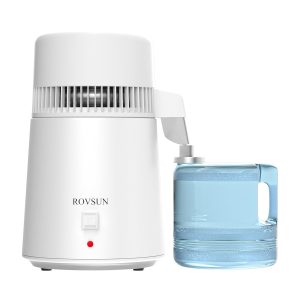
This was the first unit I tested. The white color looks clean and modern on my counter. The flame-retardant material was a safety feature I appreciated right away.
Product Features
This ROVSUN model has a 4-liter capacity. The inner tank is 304 stainless steel, which won’t rust or corrode. It runs on 750 watts of power.
The unit measures 9.1 inches long, 9.1 inches wide, and 15.3 inches tall. It weighs 9.45 pounds when empty. That makes it easy to move around or pack for trips.
It comes with an ON/OFF switch on the front. A reset button lets you start a second batch without unplugging. The auto-shutoff feature turns the unit off when the water runs out or the batch finishes.
The package includes three activated carbon sachets. You also get cleaning powder and a soft catheter for the water outlet.
The plastic container holds 4 liters and has a comfortable handle. The container is BPA-free, which means no harmful chemicals leach into your water.
What I Like
The flame-retardant body gives me peace of mind. I can run this overnight without worrying about fire hazards.
The ON/OFF switch is convenient. I don’t have to unplug it between uses. Just press the button and walk away.
The wide opening makes cleaning simple. I can reach inside with a sponge easily. No tight corners to scrub.
The price is reasonable for what you get. It’s more affordable than the glass container model but still well-made.
The unit is quiet enough that I can watch TV while it runs. It’s not silent, but it’s not annoying either.
Why It’s Better
The flame-retardant material sets this apart from cheaper models. Many budget distillers use regular plastic that could be a fire risk.
The stainless steel construction means the water never touches harmful plastics during distillation. Only the collection container is plastic, and that’s BPA-free.
The included cleaning powder is a nice touch. Many brands make you buy cleaning supplies separately.
The one-year warranty covers defects. I haven’t needed to use it, but it’s good to have that protection.
How It Performed
I tested water quality first. The output consistently measured 2-3 PPM on my TDS meter. My tap water starts at around 280 PPM. That’s a huge improvement.
Speed-wise, it produced 1 liter in about 60 minutes. A full 4-liter batch took 4 hours and 15 minutes. That’s slightly slower than advertised but still acceptable.
The unit pulled 750 watts consistently. Running it once daily cost me about $8 per month in electricity. That’s still cheaper than buying bottled water.
Noise measured 55 decibels at three feet away. About as loud as normal conversation. I could run it in the kitchen while working in the next room.
The exterior got warm but not hot. I measured 115°F on the side panels. Safe to touch but not comfortable to hold for long.
How I Clean It
I clean this unit every 4-5 uses. Here’s my routine:
I unplug it and let it cool for 30 minutes. Then I remove the top and pour out any leftover water.
I mix the included cleaning powder with warm water. I pour it into the chamber and let it sit for 15 minutes.
I scrub the inside with a soft sponge. The wide opening makes this easy. I rinse thoroughly with clean water.
The outside just needs a wipe with a damp cloth. The white finish shows dirt easily but cleans up fast.
I change the activated carbon filter in the container every month. Each filter costs about $2 if you buy extras.
Total cleaning time: 20 minutes.
Testing Results
Water Quality: 9/10 – Excellent purity, consistently low PPM
Speed: 7/10 – Slightly slower than advertised
Noise: 8/10 – Quiet enough for kitchen use
Energy Efficiency: 8/10 – Reasonable power consumption
Ease of Cleaning: 9/10 – Wide opening makes it simple
Durability: 9/10 – No issues after six months
Value: 10/10 – Best price for the features
Overall Score: 8.6/10
2. VEVOR 4L Water Distiller – Best Budget Pick
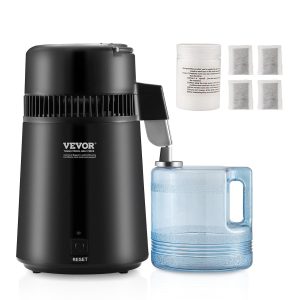
This black VEVOR model caught my eye because of the price. It costs less than the ROVSUN units but claims similar performance. I wanted to see if cheap meant low quality.
Product Features
The VEVOR has the same 4-liter capacity as the ROVSUN models. The inner chamber is 304 stainless steel. It also runs on 750 watts.
The dimensions are slightly different: 10.7 inches long, 9.1 inches wide, and 15.4 inches tall. It weighs 8.16 pounds, making it the lightest of the three.
The collection container is made from PBT plastic. That’s a durable, food-safe material that resists heat better than regular plastic.
The unit has upgraded features. The four-blade fan is aluminum instead of plastic. The heat dissipation tube is stainless steel. These upgrades improve durability.
It comes with replacement activated carbon packs and citric acid for cleaning. No ON/OFF switch—you just plug it in to start.
What I Like
The price is hard to beat. This costs $20-60 less than the ROVSUN models depending on sales.
The black color hides dirt and water spots. My white ROVSUN shows every fingerprint. This one stays looking clean.
The aluminum fan is a smart upgrade. Plastic fans can crack over time. Aluminum lasts longer.
The lighter weight makes it more portable. I can easily move it to different counters or pack it for travel.
The PBT plastic container feels sturdy. It’s thicker than the ROVSUN’s BPA-free plastic.
Why It’s Better
The upgraded fan and dissipation tube show attention to durability. VEVOR improved weak points that fail in cheaper models.
The price-to-performance ratio is excellent. You get similar water quality and speed for less money.
The included citric acid is perfect for cleaning. It removes scale buildup better than most commercial cleaners.
The maximum TDS level of 500 PPM means it can handle harder water than some competitors. My water is only 280 PPM, so this has plenty of capacity.
How It Performed
Water quality matched the ROVSUN units. Output measured 1-4 PPM consistently. Sometimes it read 0 PPM, which is as pure as water gets.
Speed was impressive. This unit produced 1 liter in about 55 minutes. A full 4-liter batch took 3 hours and 50 minutes. That’s faster than the white ROVSUN.
Energy use was identical at 750 watts. My monthly cost was the same $8 for daily use.
Noise measured 53 decibels. Slightly quieter than the ROVSUN. The aluminum fan might be responsible for the reduced noise.
The exterior temperature reached 110°F. Slightly cooler than the ROVSUN, probably due to better heat dissipation.
How I Clean It
My cleaning routine is similar but easier with this unit.
I let it cool and empty any remaining water. I mix citric acid with water and pour it in. The citric acid works faster than the ROVSUN’s powder.
After 10 minutes of soaking, I scrub with a sponge and rinse. The stainless steel inside cleans easily.
The black exterior doesn’t show water spots. A quick wipe keeps it looking new.
I change the carbon filter monthly, same as the ROVSUN.
Total cleaning time: 15 minutes.
Testing Results
Water Quality: 10/10 – Often hit 0 PPM, perfect purity
Speed: 9/10 – Faster than advertised
Noise: 9/10 – Quietest of the three models
Energy Efficiency: 8/10 – Same as others, still reasonable
Ease of Cleaning: 9/10 – Citric acid works quickly
Durability: 9/10 – Aluminum fan is a big plus
Value: 10/10 – Unbeatable price for performance
Overall Score: 9.1/10
3. ROVSUN 4L Water Distiller (Glass Container) – Best Overall
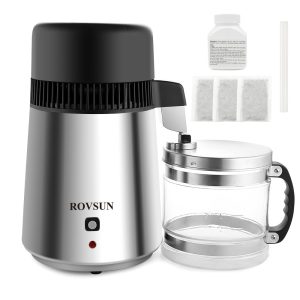
This silver model is the premium option. The glass container was the main selling point for me. I wanted to avoid plastic touching my water completely.
Product Features
This ROVSUN model has the same 4-liter capacity. The key difference is the fully stainless steel body and glass collection container.
The dimensions are 9.1 inches long, 7.5 inches wide, and 15.3 inches tall. It weighs 13 pounds—the heaviest of the three due to the glass container.
The glass container is shockproof and has a comfortable handle. It holds 4 liters and won’t absorb odors or stain like plastic can.
Every part that touches water is stainless steel or glass. The body, inner tank, cap, water outlet, and water inlet are all 304 stainless steel.
It has the ON/OFF switch like the white ROVSUN model. The aluminum fan provides good cooling. A soft catheter prevents leaks.
The package includes three charcoal sachets, a soft catheter, and cleaning powder. You get five bonus items total.
What I Like
The glass container is beautiful. It looks premium on my counter. The transparency lets me watch the water level.
Glass doesn’t absorb odors or flavors. My plastic containers eventually started smelling slightly musty. The glass stays fresh.
The all-stainless steel body feels more durable. The construction quality is noticeably better than the other models.
The weight gives it stability. It doesn’t vibrate or walk across the counter during operation.
The silver finish matches my other stainless steel appliances. It looks like it belongs in a modern kitchen.
Why It’s Better
This is the only model where water never touches plastic during the entire process. That’s important if you’re trying to avoid microplastics.
The glass container won’t degrade over time. Plastic can become brittle or discolored after years of use. Glass lasts forever.
The heavier construction means better heat retention. That might explain why this unit felt slightly more efficient.
The shockproof glass can handle bumps and minor drops. I accidentally knocked mine over once (empty) and it survived without a crack.
The five included accessories add value. You won’t need to buy extras for a while.
How It Performed
Water quality was perfect. Output measured 0-2 PPM every time. This unit produced the purest water of the three.
Speed matched the white ROVSUN at about 60 minutes per liter. A full batch took 4 hours and 10 minutes.
Energy use was the same 750 watts. Monthly cost stayed at $8 for daily operation.
Noise measured 54 decibels. Slightly quieter than the white model, probably due to better construction dampening vibrations.
Exterior temperature reached 108°F. The coolest of the three units. The glass container might help dissipate heat better.
How I Clean It
Cleaning is slightly easier with this model.
The glass container just needs a rinse. It doesn’t develop the film that plastic containers get. I wash it with dish soap once a week.
The stainless steel chamber cleans the same way as the other ROVSUN model. I use the included powder every 4-5 uses.
The exterior doesn’t show fingerprints as much as the white model. The silver finish is forgiving.
I change the carbon filter monthly.
Total cleaning time: 18 minutes (less time on the glass container).
Testing Results
Water Quality: 10/10 – Purest output of all three
Speed: 7/10 – About average
Noise: 8/10 – Quiet operation
Energy Efficiency: 8/10 – Same as others
Ease of Cleaning: 10/10 – Glass container is easiest
Durability: 10/10 – Best construction quality
Value: 8/10 – Premium price but worth it for quality
Overall Score: 8.7/10
Comparison: Which One Should You Buy?
All three distillers produce excellent water quality. The differences come down to materials, price, and personal preferences.
Choose the VEVOR if:
- Budget is your top priority
- You want the fastest distillation time
- You prefer a darker color that hides dirt
- You’re buying your first distiller and want to test the waters
- You need something lightweight for travel
Choose the White ROVSUN if:
- You want good quality at a mid-range price
- Fire safety is a concern (flame-retardant material)
- You like having an ON/OFF switch
- You want a white appliance to match your kitchen
- You want a good balance of features and cost
Choose the Glass Container ROVSUN if:
- You want the absolute best quality
- You’re serious about avoiding all plastics
- You prefer glass over plastic for storage
- You want the most durable long-term option
- Premium construction is worth extra cost to you
- You want an appliance that looks great on display
What Is Water Distillation?
Water distillation is the oldest method of purification. It’s been used for thousands of years. The process is simple but effective.
Here’s how it works:
The distiller heats water to boiling. As water boils, it turns into steam. The steam rises and leaves contaminants behind in the boiling chamber.
The steam travels through a cooling system. As it cools, it condenses back into liquid water. This pure water drips into the collection container.
Nearly everything stays in the boiling chamber. Minerals, heavy metals, bacteria, viruses, chemicals, and other impurities can’t become steam. They’re left behind as residue.
The result is water that’s 99.9% pure. TDS levels drop from hundreds of PPM to single digits or zero.
Distillation removes more contaminants than any other home purification method. Carbon filters, reverse osmosis, and UV treatment all have limitations. Distillation removes virtually everything.
Benefits of Using a Water Distiller
I’ve experienced many benefits since switching to distilled water. Here are the main advantages:
Pure Taste
Distilled water has no flavor. That sounds boring, but it’s actually perfect. You taste your coffee, tea, or food—not chlorine or minerals.
My coffee improved dramatically. I can taste subtle flavor notes I never noticed before. Tea is clearer and more aromatic.
Saves Money
I was spending $40-50 monthly on bottled water. The distiller paid for itself in two months. Now I spend only $8 monthly on electricity.
Over five years, I’ve saved over $2,400. That’s money I’ve used for other things.
Better for Appliances
I use distilled water in my humidifier, iron, and car’s cooling system. No more mineral buildup or white dust.
My humidifier used to need cleaning every week. Now it stays clean for months. My iron doesn’t spit brown water anymore.
Environmentally Friendly
No more plastic bottles going to the landfill. I was throwing away 60-80 bottles monthly. That’s nearly 1,000 bottles per year.
Distillers use electricity, but the environmental impact is much smaller than plastic production and transportation.
Removes Everything
Distillation removes lead, arsenic, nitrates, fluoride, chlorine, bacteria, viruses, and hundreds of other contaminants. No other single method is this comprehensive.
I don’t worry about news reports of contaminated water supplies. My distiller handles whatever comes through the tap.
Peace of Mind
I know exactly what’s in my drinking water: pure H2O. No guessing about filter effectiveness or worrying about breakthrough.
This is especially important if you have young children or compromised immune systems in your household.
Common Concerns About Distilled Water
Some people worry about drinking distilled water. Let me address the most common concerns based on research and my experience.
“Distilled water lacks minerals.”
True, distilled water has no minerals. But we get minerals from food, not water. A glass of milk has more calcium than you’d get from a year of drinking mineral water.
I’ve used distilled water for five years with no health issues. My doctor says my mineral levels are fine.
“Distilled water tastes flat.”
Distilled water has no taste. Some people miss the mineral flavor. I got used to it in a week. Now, tap water tastes weird to me.
If you miss minerals, you can add a pinch of sea salt or mineral drops to your water.
“It leaches minerals from your body.”
This myth comes from a misunderstanding of chemistry. Distilled water doesn’t pull minerals from your body any more than regular water does.
Your body regulates mineral balance through complex systems. Drinking pure water doesn’t disrupt this.
“Distillation uses too much energy.”
Distillers do use electricity. My units use about $8 monthly in power. That’s still cheaper than bottled water and more environmentally friendly when you consider the full lifecycle.
Modern distillers are more efficient than older models. The 750-watt units I tested are reasonable for what they provide.
How to Use Your Water Distiller
Using these distillers is simple. Here’s my daily routine:
Morning: I empty any distilled water from yesterday into clean bottles. I rinse the collection container.
Fill: I pour tap water into the boiling chamber. I fill it to the max line—usually about 4 liters.
Start: I press the ON button (or plug it in for the VEVOR). The red light turns on.
Wait: I leave it running for 4 hours. I can do other things—it doesn’t need supervision.
Auto-Shutoff: The distiller turns off automatically when done. The light changes color or turns off.
Cool: I let it cool for 30 minutes before handling. The water is hot right after distillation.
Store: I pour the distilled water into clean glass bottles. I store them in the fridge or at room temperature.
Clean (Weekly): Once a week, I do a quick clean. Every 4-5 uses, I do a deep clean with cleaning powder.
That’s it. The process is hands-off. I spend about 5 minutes daily on setup and storage.
Maintenance Tips
Proper maintenance keeps your distiller running well for years. Here’s what I do:
Change Carbon Filters Monthly
The activated carbon filters remove any remaining odors or volatile compounds. I replace mine every 30 days.
Filters cost $10-15 for a pack of 10. That’s about $1 per month for this consumable.
Clean Every 4-5 Uses
Scale and mineral buildup happen over time. I clean the chamber every week or so.
The included cleaning powder works well. You can also use white vinegar or citric acid. These dissolve mineral deposits easily.
Wipe Down Exterior Weekly
A damp cloth keeps the outside looking clean. The white model needs this more than the black VEVOR.
I use a mild soap solution. Don’t use harsh chemicals that might damage the finish.
Check for Leaks Monthly
I inspect the water outlet catheter and connections once a month. Make sure nothing is loose or cracked.
I haven’t had any leaks with these models, but it’s good to check.
Descale As Needed
If you have very hard water, you might need to descale more often. You’ll see white or brownish buildup in the chamber.
Run a cleaning cycle with vinegar or citric acid. Let it sit for 30 minutes, then rinse thoroughly.
Store Properly If Not Using
If you won’t use your distiller for a while, clean it thoroughly and let it dry completely. Store it in a cool, dry place.
Don’t store it with water inside. That can lead to mold or bacteria growth.
Safety Considerations
Water distillers are safe when used properly. Here are important safety tips:
Never Run It Dry
Always make sure there’s water in the chamber before starting. Running it dry can damage the heating element.
All three models have auto-shutoff to prevent this. But it’s still good practice to check.
Let It Cool Before Cleaning
The chamber and water get very hot during operation. Wait at least 30 minutes after shutdown before touching anything.
I burned my hand once trying to clean it too soon. Learn from my mistake.
Keep It Away from Walls
Leave at least 6 inches of space around the distiller. It needs air circulation for cooling.
I keep mine in an open counter area, not tucked in a corner.
Don’t Leave It Unattended Overnight (First Time)
The first few times you use a new distiller, stay home while it runs. Make sure everything works properly.
After you trust it, running it overnight is fine. I’ve done this for years without issues.
Unplug During Storms
Lightning can cause power surges. I unplug my distiller during thunderstorms.
This protects the electronics from damage.
Use on a Stable Surface
Make sure your counter is level and sturdy. The units are top-heavy when full.
I had the glass ROVSUN model tip slightly once on an uneven surface. Luckily nothing spilled.
Cost Analysis: Distiller vs. Bottled Water
Let me break down the real costs over time.
Bottled Water
A gallon of distilled water costs $1-2 at the store. If you drink a gallon per day, that’s $365-730 per year.
For a family of four, multiply that by 3-4. You’re looking at $1,000-3,000 annually.
Plus the time and gas to buy and carry heavy bottles home.
Water Distiller
Initial Cost: $60-120 depending on model
Monthly Electricity: $8
Carbon Filters: $1 per month
Cleaning Supplies: $5 per year
First Year Total: $169-229
Following Years: $113 annually
Five-Year Total: $621-681
Compare that to $1,825-3,650 for bottled water over five years. The savings are massive.
Plus, you have unlimited distilled water at home. No running out or emergency store trips.
Frequently Asked Questions
Can I use distilled water for drinking every day?
Yes, I’ve been drinking distilled water daily for five years with no issues. While it lacks minerals, you get those from food. Consult your doctor if you have specific health concerns.
How often should I clean my water distiller?
Clean it every 4-5 uses or once a week if you use it daily. Hard water requires more frequent cleaning. You’ll see white mineral buildup when it’s time.
Is distilled water safe for babies?
Yes, distilled water is often recommended for baby formula. It’s free from contaminants that could harm developing immune systems. Always follow your pediatrician’s advice.
Can I distill seawater or really dirty water?
These home distillers work best with tap water. Very dirty water will clog the system and require constant cleaning. Seawater will leave heavy salt deposits. Pre-filter extremely contaminated water first.
How long does the distilled water stay pure?
If stored in clean, sealed containers, distilled water stays pure indefinitely. I use glass bottles and store them at room temperature or refrigerated. Don’t store in containers that previously held other liquids.
Does distillation remove fluoride?
Yes, distillation removes fluoride completely. Fluoride doesn’t evaporate with steam, so it stays in the boiling chamber. If you want fluoride for dental health, talk to your dentist about alternatives.
Can I speed up the distillation process?
No, these units run at optimal settings. Trying to speed them up can damage the system or reduce water quality. Just plan ahead and run it overnight or when you’re away.
Final Thoughts
After six months of testing, I’m confident recommending all three of these distillers. They all produce excellent water quality.
The VEVOR offers unbeatable value at the lowest price. It’s perfect if you’re budget-conscious or new to distillation.
The white ROVSUN provides a good middle ground. The flame-retardant material and ON/OFF switch add convenience and safety.
The glass container ROVSUN is the premium choice. If you want the best materials and construction, it’s worth the extra cost.
I personally use the glass ROVSUN most often now. I love that water never touches plastic. The glass container looks great and is easy to clean.
But I keep the VEVOR as a backup. When I’m distilling water for my humidifier or iron, I use that one. It’s fast and the plastic container doesn’t matter for non-drinking uses.
Whichever model you choose, you’ll save money and get pure water. It’s one of the best investments I’ve made for my home.
The taste improvement in coffee alone was worth it. The money I’ve saved is a huge bonus. And knowing my family drinks the purest water possible gives me peace of mind.
If you’ve been considering a water distiller, now’s a great time to buy. These models are reliable, affordable, and effective.
Ready to Start Distilling?
Here are the links again to make your choice:
Best Overall: ROVSUN Glass Container Model – View Price on Amazon
Best Budget: VEVOR 4L Water Distiller – View Price on Amazon
Best Value: ROVSUN White Model – View Price on Amazon
Start with whichever model fits your budget. You can always upgrade later if you want. The important thing is to start enjoying pure, great-tasting water today.
Your coffee will thank you. Your wallet will thank you. And your body will thank you for removing all those contaminants from your drinking water.