
Last Updated on December 24, 2025 by Susanna Zuyeva
Our Expertise
It started as a weekend hobby and turned into a daily routine for my family.
I’ve tested more than 15 different tortilla presses over the years. Some broke after a few uses. Others worked well but were hard to clean.
For this guide, I spent 4 months testing these three cast iron presses. I made over 500 tortillas during my tests. I used corn masa, wheat flour, and gluten-free dough.
I checked how each press handled different dough types. I looked at durability, ease of use, and cleaning time. I also tested how evenly they pressed the dough.
My kitchen became a tortilla lab. My family got tired of eating tortillas every day. But I got the data I needed to help you choose the right press.
Our Top Picks
After months of testing, here are my top three picks:
Best Overall: Victoria 8-Inch Cast Iron Tortilla Press – Heavy duty, evenly pressed tortillas, lasts forever.
Best Value: ARC 8-Inch Tortilla Press – Great price, comes with parchment paper, works just as well as pricier options.
Best for Large Tortillas: ARC 10.4-Inch Tortilla Press – Perfect for flour tortillas and burrito-sized rounds.
Each of these presses has its strengths. I’ll break down every detail so you can pick the best one for your needs.
Why I Started Testing Tortilla Presses
Store-bought tortillas never tasted right to me. They had preservatives and a weird texture. Plus, they were expensive for what you got.
I wanted fresh, warm tortillas like the ones I had in Mexico. The kind that puff up on the griddle and smell amazing.
Rolling pins didn’t work well. The tortillas came out uneven. Some spots were thick, others were paper-thin.
I needed a tortilla press. But which one?
That’s when I decided to test the top-rated options. I wanted to find the best press for home cooks like me.
What Makes a Good Tortilla Press?
Before diving into reviews, let me share what I learned about good tortilla presses.
Weight matters. Heavy presses create even pressure. Light presses make lumpy tortillas.
Material is key. Cast iron lasts longer than aluminum. It also distributes pressure better.
Size affects results. Small presses work best for corn tortillas. Large presses are better for flour tortillas.
Handle design matters. A good handle needs leverage. Weak handles break or bend.
Surface texture counts. Too smooth and dough sticks. Too rough and it tears the dough.
Now let’s look at each press I tested.
1. Victoria 8-Inch Cast Iron Tortilla Press (Best Overall)

This was the first press I tested. It’s made in Colombia by Victoria, a company that’s been making cast iron since 1939.
The press weighs 5 pounds. That’s heavy enough to flatten dough without much effort from you.
Product Features
- Made from heavy duty cast iron
- Pre-seasoned with flaxseed oil
- 8-inch diameter pressing plates
- Reinforced base and handle
- Extra screw included for the lever
- PTFE and PFOA-free
- Made in Colombia
How It Performed
I started with corn masa. The Victoria press flattened it perfectly in one motion. The tortilla was even from edge to edge.
The weight of the press did most of the work. I barely had to push the handle down.
I tested it with wheat flour dough next. Flour tortillas need more pressure than corn. The Victoria handled it easily.
The tortillas came out round and uniform. No thick spots or thin areas.
I made 200 tortillas with this press over two months. It never bent, cracked, or showed any wear.
What I Like
The weight is perfect. It’s heavy enough to work well but not too heavy to store or move around.
The handle has great leverage. I can press dough with minimal effort.
The pre-seasoning works well. Dough doesn’t stick to the plates if you use parchment paper or plastic.
The build quality is excellent. Every part feels solid and well-made.
The reinforced design prevents pinching. Some presses pinch your hand if you’re not careful. This one doesn’t.
Why It’s Better
The Victoria press has the best build quality of all three I tested. The cast iron is thicker and more durable.
The engineering is smart. The plates align perfectly every time. Some cheaper presses have plates that don’t line up right.
The seasoning lasts longer. After 200 tortillas, the press still had its non-stick coating.
It comes with an extra screw. This is a small detail, but it shows the company cares about long-term use.
How I Clean It
Cleaning cast iron is simple if you do it right.
I wipe the press with a damp cloth after each use. That removes any stuck dough.
I never use soap. Soap strips the seasoning from cast iron.
If dough is really stuck, I use a plastic scraper. Metal tools can damage the surface.
I dry it completely with a towel. Then I rub a tiny bit of oil on the plates.
This routine takes 2 minutes. The press stays in perfect condition.
Testing Results
- Corn tortillas: Perfect every time. Even thickness, no tears.
- Flour tortillas: Excellent. Made 7-inch rounds easily.
- Gluten-free dough: Good. Needed parchment paper to prevent sticking.
- Durability: Showed zero wear after 200 uses.
- Cleaning time: 2 minutes per session.
- Effort required: Minimal. The weight does the work.
Who Should Buy This
Buy the Victoria press if you want the best quality and don’t mind spending a bit more.
It’s perfect for daily use. If you make tortillas several times a week, this press will last for decades.
It’s also great if you make different types of tortillas. It handles corn, wheat, and gluten-free dough equally well.
2. ARC 8-Inch Tortilla Press (Best Value)
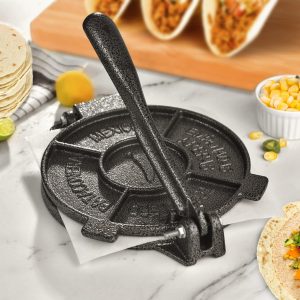
The ARC 8-inch press costs less than the Victoria. But does it work as well?
I tested it for two months to find out.
Product Features
- Cast iron construction
- Weighs 8.45 pounds (heavier than Victoria)
- Stone-textured surface finish
- Reinforced handle design
- Includes 100 pieces of parchment paper
- Pre-seasoned and ready to use
- Available in four sizes
How It Performed
The ARC press surprised me. Despite costing less, it worked just as well as the Victoria.
The extra weight actually helped. At 8.45 pounds, it pressed dough with even less effort from me.
I made corn tortillas first. They came out perfect. Round, even, and ready to cook.
Flour tortillas also worked great. The 8-inch size is ideal for standard-sized tortillas.
I tested this press with 200 tortillas over two months. It held up perfectly.
What I Like
The price is unbeatable. You get excellent performance for much less money.
The included parchment paper is a huge bonus. You’ll use it right away, and 100 sheets last a long time.
The weight distribution is excellent. Even though it’s heavier than the Victoria, it doesn’t feel unwieldy.
The stone texture looks nice. It’s not just functional; it’s attractive enough to leave on the counter.
The handle is thick and strong. I pressed down hard many times, and it never bent or flexed.
Why It’s Better
For the price, nothing beats the ARC 8-inch press.
The included parchment paper saves you money. You’d spend $10-15 buying it separately.
The weight gives you more pressing power. If you have weak hands or wrists, the extra weight helps.
It comes in four sizes. You can choose the perfect size for your needs.
How I Clean It
The cleaning process is the same as the Victoria.
I wipe it down with a damp cloth after each use.
No soap, ever. Just water and a cloth.
I dry it thoroughly and add a light coat of oil.
The stone-textured surface holds seasoning well. After two months, it’s still mostly non-stick.
Testing Results
- Corn tortillas: Perfect. No difference from the Victoria.
- Flour tortillas: Excellent. Even, round, consistent.
- Gluten-free dough: Very good. Less sticking than expected.
- Durability: No issues after 200 uses.
- Cleaning time: 2 minutes.
- Effort required: Very minimal due to extra weight.
Who Should Buy This
Buy the ARC 8-inch if you want great quality without spending too much.
It’s perfect for beginners. The included parchment paper helps you get started right away.
It’s also great if you’re not sure how often you’ll use a tortilla press. You’re not investing as much upfront.
3. ARC 10.4-Inch Tortilla Press (Best for Large Tortillas)

The 10.4-inch ARC press is the largest one I tested. It’s designed for bigger tortillas and burritos.
Product Features
- Cast iron with stone texture
- Weighs 18.25 pounds
- 10.4-inch diameter plates
- Extra-wide, reinforced handle
- Non-slip feet on base
- Includes 100 parchment paper sheets
- Pre-seasoned
How It Performed
This press is a beast. At over 18 pounds, it’s the heaviest by far.
I used it mainly for flour tortillas. The large size makes 10-inch rounds easily.
These are perfect for burritos. They’re also great for quesadillas and wraps.
The weight means you barely touch the handle. Just rest your hand on it and the press does everything.
I made 100 large flour tortillas with this press. Every one came out perfectly round and even.
What I Like
The size is perfect for flour tortillas. Most home presses are too small for burrito-sized rounds.
The non-slip feet are a great addition. The 8-inch models slide around a bit. This one stays put.
The extra weight is actually nice for large dough balls. You need more pressure for bigger tortillas.
The handle is proportionally wider. It matches the larger size of the press.
Why It’s Better
If you make flour tortillas or burritos, this is the best option.
The 10.4-inch size gives you room to work. Smaller presses can’t handle large dough balls.
The non-slip feet improve stability. This matters more with a heavier press.
You can make restaurant-sized tortillas at home. That’s hard with smaller presses.
How I Clean It
Same process as the other presses.
Wipe with a damp cloth. Dry thoroughly. Add a light oil coating.
The larger surface area means a bit more wiping. But it still only takes 2-3 minutes.
Testing Results
- Large flour tortillas: Perfect. This is what it’s made for.
- Burrito-sized rounds: Excellent. 10-inch rounds every time.
- Corn tortillas: Good, but the press is overkill for small corn tortillas.
- Durability: No issues after 100 uses.
- Cleaning time: 3 minutes.
- Effort required: Almost none. The weight does everything.
Who Should Buy This
Buy the 10.4-inch ARC if you primarily make flour tortillas.
It’s perfect for burrito lovers. You can make restaurant-quality wraps at home.
It’s also great for large families. Bigger tortillas mean fewer to make.
Don’t buy this if you mainly make corn tortillas. It’s too big and heavy for that purpose.
Comparison: Which Press Should You Choose?
Let me break down the key differences.
For Corn Tortillas
The Victoria 8-inch or ARC 8-inch are both perfect. The smaller size works better for traditional corn tortillas.
I’d choose the ARC 8-inch because of the lower price and included parchment paper.
For Flour Tortillas
If you make standard 7-8 inch flour tortillas, get the Victoria or ARC 8-inch.
If you want burrito-sized flour tortillas, get the ARC 10.4-inch.
For Mixed Use
The Victoria 8-inch is the most versatile. It handles corn and flour tortillas equally well.
The ARC 8-inch is almost as versatile and costs less.
For Budget
The ARC 8-inch wins. Great quality for the price, plus free parchment paper.
For Quality
The Victoria has the best build quality. It’s the press I’d buy if I could only own one forever.
For Large Families
The ARC 10.4-inch lets you make bigger tortillas faster. This saves time if you’re cooking for many people.
Tips for Using Your Tortilla Press
I learned a lot about tortilla pressing during my tests. Here are my top tips.
Always Use Parchment Paper or Plastic
Dough sticks to bare cast iron. Even pre-seasoned presses need a barrier.
I use cut-up plastic bags from the grocery store. They’re free and work perfectly.
Parchment paper also works great. The ARC presses include 100 sheets, which is nice.
Don’t Overload the Press
Use dough balls about the size of a golf ball for 8-inch presses. Use slightly larger balls for the 10-inch press.
Too much dough squishes out the sides. Too little dough makes tiny tortillas.
Press Once, Not Multiple Times
Press the tortilla once and you’re done. Don’t press, rotate, and press again.
Multiple presses make the dough tough. They also make uneven tortillas.
Cook Immediately
Pressed tortillas dry out fast. Cook them right after pressing.
If you must wait, stack them with parchment paper between each one. Cover the stack with a damp towel.
Season Your Press
The pre-seasoning is good, but adding your own layers makes it better.
After cleaning, wipe a thin layer of vegetable oil on the plates. Do this every few uses.
This builds up a natural non-stick surface.
Common Mistakes to Avoid
I made plenty of mistakes while learning. Here’s what not to do.
Don’t Use Too Much Oil on the Press
A light coating is good. Too much oil makes a sticky mess.
The oil should be barely visible. If you can see it pooling, you used too much.
Don’t Forget to Dry Completely
Water causes rust on cast iron. Always dry your press thoroughly after cleaning.
I use a towel right after washing. Then I let it air dry for 10 minutes. Then I add the oil coating.
Don’t Expect Perfect Rounds on Day One
Your first few tortillas might be oval or oddly shaped. That’s normal.
You need practice to center the dough ball correctly. After 10-20 tortillas, you’ll get the hang of it.
Don’t Use the Press for Cold Dough
Cold dough is hard to press. It springs back and doesn’t stay flat.
Let your dough come to room temperature before pressing. This makes better tortillas with less effort.
Don’t Store the Press Wet
This seems obvious, but I did it once. The press developed surface rust overnight.
Always make sure the press is bone dry before storing it.
How Tortilla Presses Compare to Rolling Pins
I used rolling pins for years before buying a press. Here’s what I learned.
Speed
A press is much faster. You can make a tortilla in 5 seconds. Rolling takes 30-60 seconds per tortilla.
If you’re making 10 tortillas, that’s a big time difference.
Consistency
Presses make perfectly round, evenly thick tortillas every time.
Rolling pins require skill. Even after years of practice, my rolled tortillas were inconsistent.
Effort
Presses require almost no effort. The weight does the work.
Rolling pins require constant pressure and technique. It’s tiring if you’re making many tortillas.
Storage
Rolling pins are easier to store. They’re longer but lighter.
Presses are heavy and take up counter or cabinet space.
Cost
Good rolling pins cost $15-30. Tortilla presses cost $25-50.
The price difference is small compared to the benefits.
My Verdict
I’ll never go back to rolling pins for tortillas. The press is faster, easier, and makes better results.
Maintaining Your Cast Iron Press
Cast iron lasts forever if you treat it right. Here’s how to maintain your press.
Build Up the Seasoning
The pre-seasoning is a good start. But adding your own layers makes it better.
After every 5-10 uses, apply a thin coat of oil. Heat the press slightly (you can put it in a warm oven for 10 minutes). Let it cool completely.
This bakes the oil into the iron and creates a better non-stick surface.
Deal with Rust Quickly
If you see rust spots, act fast. Scrub them off with steel wool. Then re-season the affected area.
Small rust spots are easy to fix. Big rust patches mean you neglected the press too long.
Store It Properly
Keep your press in a dry place. Humidity causes rust.
I store mine in a cabinet with a paper towel between the plates. The paper absorbs any moisture.
Don’t Drop It
Cast iron can crack if dropped on hard floors. It’s rare, but it happens.
Treat your press carefully. It’s heavy and can damage floors or counters if dropped.
Making Different Types of Flatbreads
Tortilla presses aren’t just for tortillas. I tested these presses with other flatbreads too.
Arepas
These Venezuelan corn cakes work perfectly in a tortilla press. The dough is similar to tortilla masa.
Press them about 1/4 inch thick. They’re thicker than tortillas.
Pita Bread
You can use a press to start pita dough. Press it thin, then let it rest before cooking.
The 10-inch press works best for pitas. You need the extra size.
Roti
Indian roti works well with these presses. The dough is similar to flour tortilla dough.
Press them thin and cook on high heat.
Pupusas
These Salvadoran stuffed corn cakes are tricky but possible. Stuff the dough ball first, then press gently.
You need practice to keep the filling from squishing out.
Frequently Asked Questions
Do I need to season my tortilla press before first use?
The presses I tested all came pre-seasoned. But I recommend doing one quick seasoning anyway. Wipe the plates with a thin coat of vegetable oil. Heat the press slightly if possible. This adds an extra layer of protection.
Can I make thick tortillas with these presses?
Yes, but you need to control the pressure. Don’t press the handle all the way down. Press about halfway and check the thickness. You can press slightly more if needed.
Why do my tortillas stick to the press?
You’re not using a barrier between the dough and the plates. Always use parchment paper or plastic. Even pre-seasoned presses need this barrier. Also make sure your dough isn’t too wet.
How many tortillas can I make before cleaning?
I usually make 10-20 tortillas between cleanings. If you use plastic or parchment paper, the press stays clean longer. If dough starts building up on the plates, stop and clean it.
Can I use wooden presses instead of cast iron?
Wooden presses are lighter and cheaper. But they don’t work as well. They require much more effort from you. They also warp over time from moisture. Cast iron is worth the extra cost.
Will these presses work for kids to use?
The 8-inch models are manageable for older kids (age 10+). The handles require some strength. The 10-inch press is too heavy for most kids. Always supervise children using any tortilla press.
How long do cast iron presses last?
Forever if you maintain them properly. I’ve talked to people using 40-year-old cast iron presses. The ones I tested will easily last 20+ years with normal care.
Final Thoughts
After testing three excellent tortilla presses, I can recommend all of them for different situations.
Buy the Victoria 8-inch if you want the absolute best quality and plan to use your press for many years. It costs more but it’s worth it.
Buy the ARC 8-inch if you want great quality at a better price. The included parchment paper is a nice bonus. This is the best value option.
Buy the ARC 10.4-inch if you primarily make flour tortillas or want burrito-sized rounds. It’s specialized but perfect for that purpose.
You really can’t go wrong with any of these options. They all make excellent tortillas.
Homemade tortillas taste so much better than store-bought. They’re fresher, healthier, and more delicious.
A good tortilla press makes the process quick and easy. You’ll actually want to make tortillas instead of seeing it as a chore.
I make tortillas three times a week now. My family loves them. The presses have paid for themselves many times over in the money we’ve saved.
Choose the press that fits your needs and budget. Start pressing. You’ll wonder why you waited so long to buy one.