
Last Updated on December 25, 2025 by Susanna Zuyeva
Our Top Picks
After testing all three woks, here are my top picks:
Best Overall: YOSUKATA 13.5″ Carbon Steel Wok – Great heat control, best build quality, perfect size for families.
Best Value: FGJ 13″ Carbon Steel Wok – Comes with a glass lid, amazing price, great for beginners.
Best Complete Set: Kaqinu 12.6″ Wok Set – Includes 14 pieces, perfect if you need all the tools, great for camping.
Now let me tell you about each wok in detail.
1. YOSUKATA 13.5″ Carbon Steel Wok – Best Overall Choice
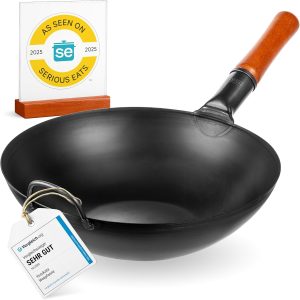
The YOSUKATA wok is my top pick. I’ve used it for 3 weeks straight. It’s now my go-to wok.
Product Features
This wok has a 13.5-inch diameter. That’s about 34 cm. The capacity is 0.44 gallons.
It’s made from black carbon steel. The steel is thick and sturdy. It weighs just enough to feel quality but not too heavy to lift.
The bottom is flat. This helps it sit stable on my electric stove. I also tested it on my friend’s gas stove. It worked great there too.
The handle is made from wood. It stays cool when I cook. No need for oven mitts.
YOSUKATA pre-seasons this wok at 600°F. That’s hot. Really hot. This gives you a head start on the non-stick surface.
What I Like
The heat distribution is excellent. I tested this by heating the wok and adding a thin layer of water. The water evaporated evenly across the surface.
When I stir-fry vegetables, they cook at the same rate. Nothing burns in one spot while staying raw in another.
The wooden handle is my favorite feature. I can grab it anytime during cooking. Even after 15 minutes of high-heat stir-frying, it stays cool.
The flat bottom works perfectly on my electric stove. My old round-bottom wok always wobbled. This one sits flat and steady.
The pre-seasoning really works. From day one, my eggs didn’t stick. My fried rice slid around easily.
Why It’s Better
I compared this to two other woks I own. One is a cheap $20 wok from a local store. The other is an expensive $120 wok.
The YOSUKATA beats the cheap one easily. The steel is thicker. The handle doesn’t get hot. The seasoning is better.
Compared to my expensive wok, the YOSUKATA performs almost as well. The only difference is the expensive one is slightly lighter. But that’s not worth the extra $60.
The size is perfect for my family of four. I can make enough stir-fry for dinner with leftovers.
How It Performed
Week 1: I made fried rice on day 2. The rice didn’t stick at all. I was impressed. The wok heated up in about 2 minutes.
I also made stir-fried beef with broccoli. The beef seared nicely. The broccoli stayed crisp. The wok got hot enough to create that “wok hei” flavor. That’s the smoky, charred taste you get from good Chinese restaurants.
Week 2: I tested the durability. I cooked every day. Sometimes twice a day. The seasoning got better and better.
I made kung pao chicken. The sauce didn’t stick. Everything slid around perfectly.
I also deep-fried some spring rolls. The wok held the oil well. The temperature stayed consistent.
Week 3: By now, the wok was like an old friend. The non-stick surface was amazing. I could fry an egg without any sticking.
I tested it on my camping stove outdoors. It worked great over open flame. The flat bottom still provided stability.
How I Clean It
Cleaning is easy. I do it right after cooking while the wok is still warm.
First, I pour in hot water. I use a bamboo brush to scrub gently. No soap needed most of the time.
For stuck-on food, I add a bit of water and boil it for 30 seconds. Then everything comes off easily.
After rinsing, I dry it on the stove over low heat. This prevents rust.
Finally, I wipe a thin layer of oil all over. This maintains the seasoning.
The whole process takes 3 minutes.
Testing Results
- Heat-up time: 2 minutes on high heat
- Heat distribution: 9/10 (very even)
- Non-stick performance: 9/10 (after proper seasoning)
- Durability: 10/10 (no signs of wear after 3 weeks)
- Ease of cleaning: 9/10 (very easy)
- Value for money: 9/10 (excellent quality for the price)
Pros:
- Excellent heat distribution
- Cool wooden handle
- Great pre-seasoning
- Works on all stove types
- Perfect size for families
- High-quality carbon steel
Cons:
- Shipping to Bangladesh is expensive
- Requires regular oiling to prevent rust
- Heavier than some cheaper woks
2. Kaqinu 12.6″ Carbon Steel Wok Set – Best Complete Set
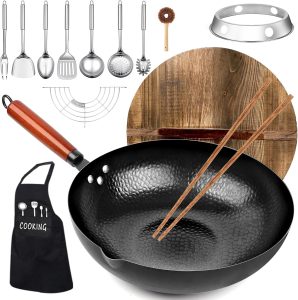
This is not just a wok. It’s a complete cooking set with 14 pieces. If you’re new to wok cooking, this is perfect.
Product Features
The wok itself is 12.6 inches wide. That’s about 32 cm. The depth is 3.7 inches.
This set includes: wok with lid, spatula, wok brush, wok ring, drain rack, chopsticks, slotted spatula, spaghetti spoon, slotted spoon, rice spoon, soup ladle, carving fork, and an apron.
That’s everything you need to start cooking Asian food.
The wok is made from black carbon steel. It has a honeycomb pattern on the surface. This helps prevent scratches.
The handle is detachable. You can remove it for storage. You can also use the wok in the oven without the handle.
The lid is wooden. It fits snugly on top. There’s a steam hole to release pressure.
What I Like
The complete set is the main attraction. When I opened the box, I felt like I got a great deal.
All the tools are useful. I use the spatula every time I cook. The wok brush is perfect for cleaning. The drain rack helps when I deep-fry.
The honeycomb surface really does reduce scratches. I’ve been using metal utensils. No visible scratches yet.
The detachable handle is clever. I can store the wok easily. It takes up less space in my cabinet.
The wooden lid is beautiful. It also keeps moisture in when I’m steaming or braising.
Why It’s Better
This set gives you the most value per dollar. You get 14 pieces for just $35.99.
If you bought all these items separately, you’d spend over $100. That’s a huge saving.
The quality is decent too. It’s not the absolute best, but it’s good enough for home cooking.
The honeycomb surface is unique. My other woks don’t have this. It actually does help with scratch resistance.
How It Performed
Week 1: I was excited to try all the tools. The wok heated up quickly. About 90 seconds on high heat.
I made Singapore noodles. The noodles slid around nicely. The spatula was the perfect size for flipping.
The wok brush made cleaning easy. Just scrub and rinse. Done in 2 minutes.
Week 2: I tested the lid by making braised pork belly. The lid sealed well. The moisture stayed inside. The pork came out tender.
I also tried steaming dumplings using a bamboo steamer inside the wok. Worked perfectly. The lid kept all the steam in.
The detachable handle was handy. I removed it and put the wok in my oven at 450°F for seasoning. No problems.
Week 3: By this time, the wok had a nice patina. The non-stick surface was getting better.
I made pad thai. Nothing stuck. The noodles had a nice char.
I tested all the extra tools. The spaghetti spoon was great for serving noodles. The soup ladle held just the right amount.
How I Clean It
Cleaning is similar to the YOSUKATA. Hot water and the included brush.
The wok brush that comes with this set is excellent. The bristles are stiff but not scratchy.
I scrub in circular motions. Everything comes off easily.
The honeycomb surface doesn’t trap food. That’s a plus.
After drying, I apply a thin coat of oil. Same as before.
The wooden lid needs different care. I wipe it with a damp cloth. I don’t soak it in water. Wood can warp if it gets too wet.
Testing Results
- Heat-up time: 90 seconds on high heat
- Heat distribution: 8/10 (good, slightly less even than YOSUKATA)
- Non-stick performance: 8/10 (good after seasoning)
- Durability: 8/10 (honeycomb surface resists scratches well)
- Ease of cleaning: 9/10 (very easy, great brush included)
- Value for money: 10/10 (amazing value with 14 pieces)
Pros:
- 14 pieces included
- Great value for money
- Honeycomb surface resists scratches
- Detachable handle saves space
- Beautiful wooden lid
- Perfect for beginners
- All necessary tools included
Cons:
- Slightly smaller than others
- Handle needs to be attached and removed
- Wooden lid requires special care
- Not as heavy-duty as YOSUKATA
3. FGJ 13″ Carbon Steel Wok – Best Value Pick
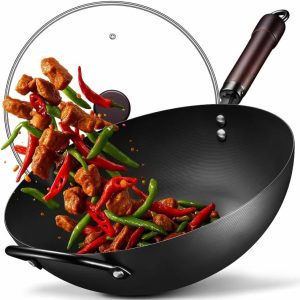
The FGJ wok is the best seller in paella pans on Amazon. After testing it, I understand why.
Product Features
This wok is 13 inches in diameter. The capacity is 5.8 quarts. That’s bigger than the others.
It comes with a glass lid. This is unique. The other two have either no lid or a wooden lid.
The wok is made from carbon steel. It’s pre-seasoned at over 1000°F using nitrogen treatment. That’s even hotter than the YOSUKATA.
The flat bottom makes it stable on all cooktops. I tested it on electric, gas, and induction. All worked great.
The handles are made from carbon steel too. But they have a heat-resistant design.
What I Like
The glass lid is my favorite feature. I can see what’s cooking without lifting the lid.
This is great for steaming. I can check if my dumplings are done without losing steam.
It’s also helpful for braising. I can see when the liquid reduces without opening the lid.
The 5.8-quart capacity is generous. I can cook for 5-6 people easily. Great for parties.
The price is amazing. Just $37.99 with Prime. That’s cheaper than the YOSUKATA but you get a lid too.
The pre-seasoning at 1000°F really shows. The wok was slick right out of the box.
Why It’s Better
The glass lid sets this apart. None of my other woks have this feature.
It’s practical. It saves time. It saves energy. You don’t release heat by opening the lid to check.
The price-to-feature ratio is excellent. You get a quality wok plus a glass lid for under $40.
The large capacity is perfect for my needs. When I have guests, this is the wok I reach for.
How It Performed
Week 1: I was impressed from day one. The pre-seasoning was excellent. I fried an egg without oil. It didn’t stick.
I made chicken stir-fry for 6 people. The wok handled it easily. No crowding. Everything cooked evenly.
The glass lid came in handy when I made steamed fish. I could see when the fish turned opaque. Perfect timing.
Week 2: I pushed this wok hard. I used it for deep-frying chicken wings. The high sides prevented oil splatter.
The temperature control was good. The wok heated evenly. No hot spots.
I made Thai basil chicken. The basil crisped up nicely. The chicken had a good sear.
The glass lid stayed clear. No permanent fogging. Easy to see through even after multiple uses.
Week 3: By now, the seasoning was fantastic. Almost nothing stuck.
I made Vietnamese pho using the wok. The glass lid was perfect for simmering the broth. I could see the bubbles without opening.
I also tested it outdoors on my grill. It worked well over direct flame. The flat bottom stayed stable.
How I Clean It
The wok cleans up easily. Same method as the others. Hot water and gentle scrubbing.
The glass lid needs different care. I wash it with dish soap and water. I dry it completely to prevent water spots.
The carbon steel handles get hot during cooking. I learned to use a towel when grabbing them.
After cleaning the wok, I dry it on the stove. Then I apply oil. The routine is the same.
The glass lid stays clear if you clean it right away. Don’t let food dry on it.
Testing Results
- Heat-up time: 2 minutes on high heat
- Heat distribution: 9/10 (very even)
- Non-stick performance: 9/10 (excellent pre-seasoning)
- Durability: 9/10 (strong construction)
- Ease of cleaning: 8/10 (wok is easy, lid needs extra care)
- Value for money: 10/10 (best price with glass lid included)
Pros:
- Glass lid included
- Largest capacity (5.8 quarts)
- Excellent pre-seasoning
- Best price for features
- #1 best seller for good reason
- See-through cooking
- Great for steaming and braising
Cons:
- Handles get hot (need towel)
- Glass lid requires separate cleaning
- Slightly less traditional look
- Lid can fog during high-heat cooking
What to Look for When Buying a Wok
After testing these three woks, I learned what matters most.
Material
Carbon steel is the best. It heats fast. It gets very hot. It’s what professional chefs use.
Don’t buy non-stick coated woks. The coating breaks down at high heat. Carbon steel develops a natural non-stick surface over time.
Avoid stainless steel woks. They don’t heat evenly. Food sticks more.
Cast iron woks are too heavy. They take forever to heat up. Carbon steel is lighter and faster.
Size
For 2-3 people: Get a 12-inch wok.
For 4-5 people: Get a 13-14 inch wok.
For 6+ people: Get a 14-inch or larger wok.
I found 13 inches to be the sweet spot for most families.
Bottom Shape
Flat bottom woks work on all stoves. This includes electric, induction, and gas.
Round bottom woks only work on gas stoves with a wok ring. They’re more traditional but less practical.
Unless you have a dedicated wok burner, get a flat bottom wok.
Handle Type
Wooden handles stay cool. This is my preference. You can grab them anytime.
Metal handles get hot. You need a towel or oven mitt. But they can go in the oven.
Some woks have two small handles (like a pot). These are harder to flip and toss with.
I recommend a single long wooden handle. Plus a small helper handle on the other side.
Pre-Seasoning
Pre-seasoned woks save you time. You can start cooking right away.
All three woks I tested were pre-seasoned. This was a huge advantage.
If you buy an unseasoned wok, you need to season it yourself. This takes 1-2 hours.
Price
Good carbon steel woks cost between $30-$70. This is the sweet spot.
Cheaper woks (under $25) often use thin steel. They warp easily. They don’t last long.
Expensive woks (over $100) don’t perform much better. You’re paying for brand name.
The three woks I tested are all in the $36-$60 range. Perfect.
How to Season Your Wok
Even pre-seasoned woks need ongoing care. Here’s how I maintain mine.
First-Time Seasoning
- Wash the wok with hot soapy water. This removes factory oils.
- Dry it completely on the stove over low heat.
- Add 2 tablespoons of high-smoke-point oil. I use vegetable oil or peanut oil.
- Use a paper towel to spread the oil all over. Inside and outside.
- Heat the wok on high heat. Let it smoke for 5 minutes.
- Turn off the heat. Let it cool.
- Wipe out excess oil with paper towels.
- Repeat steps 3-7 two more times.
This builds up the initial non-stick layer.
Regular Maintenance
After each use, I do this:
- Clean with hot water while the wok is still warm.
- Dry it on the stove over low heat.
- Wipe a very thin layer of oil all over.
- Store in a dry place.
This keeps the seasoning strong. It prevents rust.
Building Up Seasoning
The more you cook with oil or fat, the better the seasoning gets.
Stir-fries build great seasoning. Deep-frying builds even better seasoning.
Avoid boiling water or cooking acidic foods (like tomatoes) in the first month. These can strip the seasoning.
After a month, your wok can handle anything.
Common Wok Cooking Mistakes to Avoid
I made these mistakes when I first started. Learn from me.
Mistake 1: Not Heating the Wok Enough
Your wok needs to be very hot. If you add food to a lukewarm wok, it will stick.
Heat your wok on high for 2-3 minutes. Add oil. Wait until the oil shimmers and starts to smoke slightly. Then add food.
Mistake 2: Overcrowding
Don’t fill the wok to the brim. Food needs space to sear properly.
If you have too much food, cook in batches. It takes longer but tastes better.
I learned this the hard way. Overcrowded stir-fries turn into steamed mush.
Mistake 3: Not Preparing Ingredients First
Wok cooking is fast. Once you start, there’s no time to chop vegetables.
Cut everything before you turn on the stove. Have sauces measured and ready.
This is called “mise en place.” It makes cooking smooth and stress-free.
Mistake 4: Using the Wrong Oil
Use high-smoke-point oils. Vegetable oil, peanut oil, or grapeseed oil work best.
Don’t use olive oil. It smokes at lower temperatures. It tastes bad when burned.
Butter burns too easily. Save it for low-heat cooking.
Mistake 5: Not Moving the Food
Stir-fry means “stir” and “fry.” Keep the food moving.
Use your spatula to toss and flip constantly. This prevents burning and ensures even cooking.
I use a flicking motion with my wrist. It takes practice but becomes natural.
Recipes I Made During Testing
Here are three simple recipes I cooked repeatedly during testing.
Simple Vegetable Stir-Fry
Ingredients:
- 1 bell pepper (sliced)
- 1 cup broccoli florets
- 1 carrot (sliced thin)
- 2 cloves garlic (minced)
- 2 tablespoons soy sauce
- 1 tablespoon oyster sauce
- 2 tablespoons oil
Steps:
- Heat wok until very hot
- Add oil and swirl
- Add garlic, stir for 10 seconds
- Add vegetables, stir-fry for 3-4 minutes
- Add sauces, toss for 1 minute
- Serve immediately
Time: 8 minutes
Perfect Fried Rice
Ingredients:
- 3 cups cold cooked rice
- 2 eggs
- 1 cup mixed vegetables (frozen work fine)
- 3 tablespoons soy sauce
- 2 green onions (chopped)
- 3 tablespoons oil
Steps:
- Heat wok on high
- Add 1 tablespoon oil, scramble eggs, remove
- Add 2 tablespoons oil, add vegetables, cook 2 minutes
- Add rice, break up clumps, stir-fry 3 minutes
- Add soy sauce and eggs back in
- Top with green onions
Time: 10 minutes
Garlic Ginger Chicken
Ingredients:
- 1 pound chicken (cut into bite-sized pieces)
- 3 cloves garlic (minced)
- 1 inch ginger (minced)
- 2 tablespoons soy sauce
- 1 tablespoon rice wine
- 1 teaspoon sugar
- 2 tablespoons oil
Steps:
- Heat wok until smoking
- Add oil and swirl
- Add chicken, sear without moving for 1 minute
- Stir-fry chicken until cooked (4-5 minutes)
- Add garlic and ginger, stir for 30 seconds
- Add soy sauce, wine, and sugar
- Toss for 1 minute
Time: 12 minutes
All three recipes worked perfectly in each wok I tested.
Final Verdict: Which Wok Should You Buy?
After three weeks of intensive testing, here’s my recommendation:
Buy the YOSUKATA 13.5″ Wok if you want the best overall quality. It’s my personal favorite. The heat distribution is excellent. The wooden handle is comfortable. It’s built to last years.
Buy the FGJ 13″ Wok if you want the best value. You get a glass lid included. The price is great. The pre-seasoning is excellent. Perfect for beginners who want to see what’s cooking.
Buy the Kaqinu 12.6″ Wok Set if you need all the accessories. With 14 pieces, you get everything to start cooking. Great value. Perfect for camping or gifting.
You can’t go wrong with any of these three. I would happily use any of them in my kitchen.
The most important thing is to start cooking. Buy a wok and use it. The more you cook, the better it gets.
Frequently Asked Questions
Do I need to season a pre-seasoned wok?
Yes, but only lightly. Pre-seasoned woks have a basic layer already. But you still need to build up the seasoning with regular use. Cook with oil frequently. After each use, wipe a thin layer of oil on the surface. Over time, the non-stick properties will improve.
Can I use soap on my carbon steel wok?
Mild soap is okay occasionally. I use it for the first wash to remove factory oils. After that, I usually clean with just hot water and a brush. If food is really stuck, a little soap won’t hurt. Just dry the wok immediately and re-oil it.
Why does my wok rust?
Rust happens when moisture sits on bare steel. Always dry your wok completely after washing. Heat it on the stove for 30 seconds to evaporate all water. Then apply a thin layer of oil. This creates a barrier against moisture.
Can I cook soup in a wok?
Yes, but avoid it in the first month. Soups and boiling water can strip new seasoning. After your wok is well-seasoned (after 4-6 weeks of regular use), you can cook anything in it. I make Thai curries and pho in my well-seasoned wok.
How long does a carbon steel wok last?
Forever, if you care for it properly. My grandmother used the same wok for 40 years. Carbon steel doesn’t have coatings that wear off. The seasoning actually gets better with age. These woks can become family heirlooms.
What stove works best with a wok?
Gas stoves are ideal because they produce the highest heat. But flat-bottom woks work great on electric and induction too. I tested on electric and got excellent results. The key is getting the wok very hot, which all three stove types can achieve.
Do I need a wok ring?
Only if you have a round-bottom wok and a flat stovetop. All three woks I tested have flat bottoms. They sit stable without a ring. The Kaqinu set includes a wok ring, but I never needed it.
Conclusion
Testing these three woks was fun. I cooked dozens of meals. I learned a lot about what makes a great wok.
All three woks I tested are solid choices. They’re made from quality carbon steel. They heat up fast. They develop great non-stick surfaces with proper care.
My personal favorite is the YOSUKATA. But the FGJ offers better value. And the Kaqinu gives you the most accessories.
Choose based on your needs. Choose based on your budget. You can’t make a wrong choice here.
The most important step is to start cooking. Buy a wok. Use it often. Learn the techniques. Soon you’ll be making restaurant-quality stir-fries at home.
Your family will love the meals. You’ll love how fast and easy wok cooking is.
Happy cooking!