
Last Updated on June 24, 2026 by Kathay Lee
Follow these simple steps for the best results.
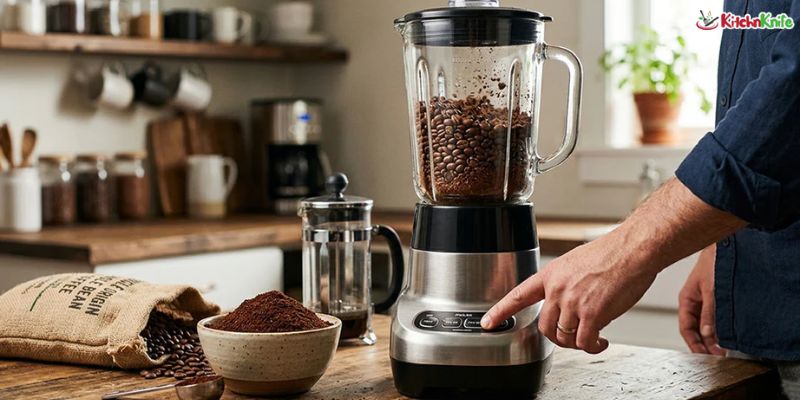
Step 1: Add the beans Pour no more than half a cup of whole coffee beans into the blender jar. Do not overfill it.
Step 2: Secure the lid Always hold the lid down firmly. Coffee beans can jump and make a mess.
Step 3: Use the pulse setting Pulse in short 2 to 3 second bursts. Do not run the blender continuously. Pulsing gives you more control over the grind size.
Step 4: Check the grind After every few pulses, stop and check the consistency. Shake the jar gently to move larger pieces to the top.
Step 5: Repeat as needed Keep pulsing until you reach your desired grind size. This usually takes 10 to 15 short pulses.
What Grind Size Can a Blender Achieve?
A blender works best for these grind sizes:
Coarse grind — great for French press and cold brew. Easy to achieve with fewer pulses.
Medium grind — works well for drip coffee makers. Requires more pulses and careful checking.
Fine grind — possible but difficult. Results are often uneven. Not ideal for espresso.
A standard blade grinder or burr grinder will always produce a more consistent grind. But for coarse and medium grinds, a blender does a decent job.
Tips for Better Results
These small tricks make a big difference.
Keep it cool. Heat ruins coffee flavor. Grind in short bursts to avoid overheating the beans.
Work in small batches. Do not grind more than half a cup at a time. Smaller batches grind more evenly.
Use a high powered blender. A blender with at least 500 watts gives better results. Brands like Vitamix or Ninja handle coffee beans well.
Clean the blender first. Leftover food odors can transfer to your coffee. Rinse and dry thoroughly before grinding.
Tilt and shake. Between pulses, tilt the blender slightly to redistribute the beans. This helps even out the grind.
Blender vs. Coffee Grinder
| Feature | Blender | Burr Grinder |
|---|---|---|
| Grind consistency | Uneven | Very consistent |
| Cost | Already own it | Extra cost |
| Grind size control | Limited | Precise |
| Best for | Coarse/medium | All grind sizes |
| Cleanup | Easy | Moderate |
A dedicated burr grinder is the gold standard for coffee grinding. It produces a uniform grind every time, which leads to better extraction and better taste. However, a blender is a perfectly fine tool when you do not have a grinder nearby.
When to Use a Blender to Grind Coffee
A blender is the right call in these situations:
Your grinder broke. Do not skip your morning coffee. Use the blender until you replace or fix your grinder.
You are traveling. Many vacation rentals have blenders but no grinders. A blender gets the job done.
You bought whole beans by mistake. It happens. A quick blender grind saves the day.
You are making French press or cold brew. These methods use coarse grinds, which a blender handles well.
Frequently Asked Questions
Will grinding coffee beans damage my blender? Coffee beans are hard but not hard enough to damage a quality blender. Avoid doing it every single day, as it can dull the blades over time.
Can I use a NutriBullet to grind coffee? Yes. A NutriBullet works well for coffee grinding. Use the milling blade if your model comes with one.
Can I grind coffee in a food processor? Yes. A food processor works similarly to a blender and gives decent coarse grinds.
How much coffee should I grind at once? No more than half a cup of whole beans per batch. Smaller amounts grind more evenly.
Does blender ground coffee taste different? It can taste slightly different due to uneven grind size. Uneven grinds cause over extraction and under extraction in the same cup. That said, most people find it perfectly drinkable.
Final Thoughts
Can you grind coffee beans in a blender? Absolutely yes. It is not the perfect method, but it works well enough for everyday brewing. For French press and cold brew especially, a blender does a solid job.
If you drink coffee daily and care about taste, invest in a burr grinder. But for those emergency mornings or travel situations, your blender has you covered.
Keep your batches small, use the pulse setting, and you will have a decent cup of coffee in minutes.