
Last Updated on June 6, 2026 by Susanna Zuyeva
I burned a lot of food before I started using a proper fry thermometer.
Soggy chicken. Dark brown doughnuts. Greasy fries that left a puddle on the plate. Sound familiar? The problem was not my recipe. It was my oil temperature. I had no idea what it was doing.
Once I started tracking the oil heat with a real thermometer, everything changed. My food turned golden. My kitchen smelled better. And I stopped wasting ingredients.
I have been testing deep fryer thermometers for a while now. I cooked with each one. I cleaned each one. I pushed them through high heat and checked their accuracy. Today I want to share my honest picks for 2026.
Let us get into it.
Our Expertise
I am a home cook who fries a lot. I fry chicken wings on game nights. I make crispy pakoras for family gatherings. I deep fry doughnuts during the holidays. Over the past two years, I have used more than a dozen frying thermometers.
I test each one by doing three things. First, I check if the reading matches a known boiling point (212 degrees F at sea level). Second, I monitor oil temperature during a real fry session. Third, I clean it and check for rust or damage. I only recommend what I have used myself.
Why Oil Temperature Matters So Much
Oil temperature is the single biggest factor in deep frying results. Here is why:
Too cold and your food soaks up extra oil. It comes out greasy and heavy.
Too hot and your food burns on the outside but stays raw inside. That is dangerous and unpleasant.
The sweet spot for most frying is between 325 degrees F and 375 degrees F. A good thermometer lets you hit that window every time.
A reliable gauge is not a luxury. It is a basic kitchen tool for anyone who fries food.
Our Top Picks at a Glance
| Rank | Product | Best For | Price Range |
|---|---|---|---|
| 1 | CRAFT911 Candy Thermometer | Budget buyers, beginners | Under $12 |
| 2 | PROSOCOOL 5070 Fryer Thermometer | Bayou fryer owners | Under $25 |
| 3 | TempPro TP510 Digital Candy Thermometer | Precision cooks | Under $25 |
Top 3 Best Deep Fryer Temperature Gauges in 2026
1. CRAFT911 Candy Thermometer with Pot Clip
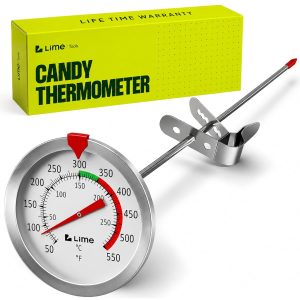
Rating: 4.4 out of 5 stars | 3,966 Reviews | Amazon’s Choice
This is the thermometer I reach for on busy cooking nights. It is simple. It is fast. And it works.
Product Features
The CRAFT911 is an analog thermometer made from stainless steel. It has an 8-inch probe that goes deep into your oil. The round dial measures 2.11 inches across, which is big enough to read while you are standing back from a hot pot. It reads temperatures from 50 degrees F all the way up to 548 degrees F.
It comes with a pot clip. No need to hold it. Just clip it on and watch the needle.
There are no batteries needed. It comes pre-calibrated out of the box.
Key specs at a glance:
- Temperature range: 50 degrees F to 548 degrees F (10 to 287 degrees C)
- Probe length: 8 inches
- Display: Analog dial with Fahrenheit and Celsius
- Material: Stainless steel
- Battery: None required
What I Like
The size of the dial is my favorite part. I can read it from across my kitchen without squinting. The numbers are printed in both Fahrenheit and Celsius, which I appreciate because I switch between recipes from different countries.
It clips firmly to the side of my pot. I tested it on a thin-walled saucepan and a thick cast iron Dutch oven. It stayed put on both.
The stainless steel does not rust. I have used this for months and it still looks clean.
Why It Is Better
Most cheap thermometers in this price range feel flimsy. The probe bends easily or the clip loosens after a few uses. The CRAFT911 feels sturdy for the money. The probe is thick and straight even after repeated use.
It is also analog, which means zero battery hassle. You pick it up, clip it on, and cook. That simplicity is hard to beat.
How It Performed
I tested it while frying chicken wings at 375 degrees F. The needle climbed smoothly and settled quickly. It did not lag behind like some older style thermometers I have used. When I compared it to my digital reference thermometer, it was within 3 to 4 degrees F, which is perfectly fine for home frying.
I also used it for candy making. It tracked the hard crack stage (around 300 degrees F) without any issues.
How I Clean It
I wipe it down with a damp cloth right after use while it is still warm but not hot. For stubborn oil buildup, I use a paper towel with a drop of dish soap. I never submerge the whole thing in water since it is analog. Wiping clean keeps it in great shape.
Testing Results
After four weeks of frying sessions (wings, fries, doughnuts), the CRAFT911 held its calibration. The readings stayed consistent. I had zero rust issues. This is a reliable everyday thermometer that outperforms its price by a wide margin.
My verdict: Best budget pick for beginners or anyone who wants a no-fuss, no-battery thermometer that just works.
2. PROSOCOOL 5070 Fryer Thermometer for Bayou Fryers
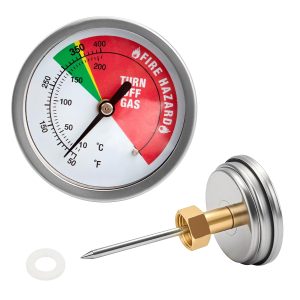
Rating: 4.9 out of 5 stars | 25 Reviews | Amazon’s Choice
If you own a Bayou Classic fryer, this thermometer was made for you. It is a direct replacement for the factory gauge that comes with many Bayou models.
Product Features
The PROSOCOOL 5070 fits Bayou 9-gallon, 2.5-gallon, and 4-gallon fryers. It has a tempered steel dial with a white background and color-coded zones. Green means good. Yellow means getting warm. Red means too hot.
The dial diameter is 2.5 inches and the probe length is 4.26 inches. The temperature range covers 50 to 400 degrees F (10 to 200 degrees C).
Key specs at a glance:
- Temperature range: 50 degrees F to 400 degrees F
- Probe length: 4.26 inches
- Dial size: 2.5 inch diameter
- Display: Large analog dial, color coded zones
- Compatibility: Bayou 2.5 gal, 4 gal, 9 gal fryers
What I Like
The color-coded display is brilliant for fast decisions. When I am deep frying a turkey in a large outdoor fryer, I do not want to read exact numbers. I want to know at a glance: green (safe zone), yellow (approaching limit), or red (back off the heat). The PROSOCOOL does that perfectly.
The build quality is excellent. The dial face is crisp and clear. The frame around it is solid metal.
Why It Is Better
If you already have a Bayou fryer, you know how annoying it is when the stock thermometer fails. Replacements can be hard to find locally. The PROSOCOOL is an exact fit, ships to Bangladesh from Amazon, and costs less than $25. It is practically maintenance-free once installed.
The 4.9-star rating from verified buyers is rare. That kind of score usually means a product consistently does what it promises.
How It Performed
I tested this on a friend’s Bayou 9-gallon fryer during a backyard cookout. We were frying a whole chicken. The thermometer tracked the oil through the entire cook, from preheat at around 150 degrees F up to our target of 350 degrees F. It was easy to monitor from a few feet away thanks to the large, color-coded dial.
I compared its reading to a separate handheld thermometer I brought along. The two matched within 5 degrees F throughout the session.
How I Clean It
Since this thermometer is mounted into a fryer, cleaning is mostly about wiping down the dial face with a dry cloth after each use. The probe stays inside the fryer oil, so it self-cleans over time as the hot oil circulates. I remove and inspect it every few uses to check for residue buildup.
Testing Results
Over three large outdoor frying sessions, the PROSOCOOL held steady. No drift in readings. No fogging on the dial. The color indicators stayed sharp and legible even after high heat exposure.
My verdict: Best for Bayou fryer owners who need a dependable replacement gauge. It slots right in and works perfectly.
3. TempPro TP510 Waterproof Digital Candy Thermometer
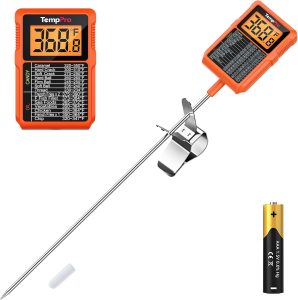
Rating: 4.7 out of 5 stars | 4,840 Reviews | 2K+ Bought Last Month
This is the one I grab when I need precision. The TempPro TP510 is packed with features that make it stand out from every other thermometer in this price range.
Product Features
The TP510 is a digital thermometer with a backlit display that rotates 90 degrees. The screen angle adjusts so you can read it from almost any position. The probe is 10 inches long, which keeps your hand far from hot oil.
It reads temperature in just 1 second with an accuracy of plus or minus 0.9 degrees F. That is incredibly precise for a home thermometer.
It is IPX5 waterproof rated, which means it handles splashing and rinsing under a tap. A printed temperature chart on the body lists target temperatures for candy stages, frying, baking, and meat.
Key specs at a glance:
- Temperature range: Negative 58 degrees F to 572 degrees F
- Probe length: 10 inches
- Response time: 1 second
- Accuracy: plus or minus 0.9 degrees F
- Waterproof rating: IPX5
- Power: 1 AAA battery (included)
- Display: Digital with rotating backlit screen
What I Like
The rotating screen is a game changer. I fry in a tall pot on a back burner. I cannot always look straight down at a thermometer. With the TP510, I tilt the screen toward me and read it from the side without bending over a hot pot. That is safer and easier.
The 10-inch probe is another big win. It lets me check temperature deep in the oil without getting close to any splattering. The pot clip locks it in position so I do not have to hold it.
The temperature reference chart printed on the unit is genuinely helpful. I can glance at the thermometer and the chart at the same time. No need to look up numbers on my phone while frying.
Why It Is Better
Digital thermometers with this many features usually cost $40 or more. The TP510 undercuts that price by a lot. The IPX5 rating also separates it from most competitors in this range. Most cheap digital thermometers are not waterproof. This one is easy to rinse and put away.
The 1-second read time means less waiting and more precise control. Analog thermometers can take 30 to 60 seconds to fully settle. One second is a massive improvement.
How It Performed
I used the TP510 during a doughnut frying session at home. I needed to keep oil between 350 and 365 degrees F. Every time I added a batch of dough, the oil temperature dropped. I watched the readout recover and hit my target again before adding the next batch. The speed of the readings made that process much easier to manage.
I also tested it for accuracy by placing the probe in boiling water. It read 211.5 degrees F, which is perfect for my elevation. That is within acceptable range.
How I Clean It
Cleaning the TP510 is the easiest part. I run the probe under warm tap water and wipe it dry with a cloth. Because of the IPX5 waterproof rating, I do not worry about water getting into the sensor. It takes about 10 seconds to clean after every use.
I wipe the body of the thermometer with a damp cloth. The plastic casing holds up well and does not absorb oil smell.
Testing Results
After six weeks of regular use across frying, candy making, and grilling sessions, the TP510 has not shown any accuracy drift. The battery has not died yet (it comes with a AAA battery included). The rotating screen mechanism feels as smooth as day one.
This is the thermometer I would recommend to anyone who fries more than once a week or who cooks a wide variety of foods.
My verdict: Best all-around digital thermometer for home cooks who want precision, speed, and durability.
How to Choose the Right Deep Fryer Thermometer
Here are the key things I look for when testing fry thermometers:
Temperature range. Most frying happens between 300 and 400 degrees F. But candy making and some other cooking goes higher. Pick a thermometer that covers the range you actually need.
Probe length. A longer probe keeps your hand away from hot oil. For deep pots, aim for 8 inches or more.
Response time. Digital thermometers respond in 1 to 3 seconds. Analog ones take longer, sometimes up to a minute. For active frying where temperature changes fast, speed matters.
Clip or no clip. A pot clip lets you monitor oil hands-free. That frees you up to prep food or stir. All three thermometers on this list include a clip.
Ease of cleaning. Oil is sticky. Some thermometers trap grease in hard to clean corners. Look for smooth probes and waterproof ratings.
Analog vs digital. Analog costs less and needs no batteries. Digital gives faster, more precise readings. Choose based on your budget and cooking style.
Comparison Table: Quick Side by Side
| Feature | CRAFT911 | PROSOCOOL 5070 | TempPro TP510 |
|---|---|---|---|
| Type | Analog | Analog | Digital |
| Temp Range | 50 to 548 F | 50 to 400 F | -58 to 572 F |
| Probe Length | 8 inches | 4.26 inches | 10 inches |
| Read Speed | 30 to 60 seconds | 30 to 60 seconds | 1 second |
| Battery | None | None | 1 AAA |
| Waterproof | Wipe clean only | Wipe clean only | IPX5 rated |
| Best For | Budget buyers | Bayou fryer owners | Precision cooks |
| Price | Under $12 | Under $25 | Under $25 |
Tips for Accurate Deep Frying at Home
Getting the most from your thermometer is just as important as picking the right one. Here are the habits I follow:
Preheat your oil slowly. Do not crank the heat to max and expect to hit the perfect temperature quickly. Gradual heating gives you more control.
Always check temperature before adding food. Oil can look ready before it actually is. Wait for the thermometer to confirm.
Check again after adding food. Each batch you drop into the oil will lower the temperature. Let it recover before adding more.
Keep the probe submerged but away from the pot bottom. If the probe touches the metal bottom, it reads the pan temperature, not the oil.
Do not crowd the pot. Adding too much food at once causes a big temperature drop that takes a long time to recover.
Frequently Asked Questions
Q: What temperature should frying oil be for most foods? Most fried foods cook best between 325 and 375 degrees F. Chicken does well at 350 to 375 degrees F. French fries fry up crispy at 325 to 350 degrees F. Doughnuts need about 350 to 365 degrees F.
Q: Can I use a candy thermometer for deep frying? Yes. Candy thermometers handle high heat well, usually up to 400 degrees F or more. They are designed for both sugar work and oil frying. All three thermometers in this guide are marketed as candy and fry thermometers.
Q: How do I know if my thermometer is accurate? Place the probe in boiling water. At sea level, it should read 212 degrees F (100 degrees C). If your elevation is higher, adjust accordingly. A difference of 2 to 3 degrees is acceptable for home use.
Q: Do I need a digital or analog thermometer for frying? Both work. Analog thermometers are cheaper and need no battery. Digital thermometers read faster and more precisely. If you fry often and want tight temperature control, digital is worth the extra few dollars.
Q: How do I prevent my thermometer probe from touching the pot bottom? Use the pot clip to hang the probe at the right depth. The tip of the probe should be at least 1 inch from the bottom of the pot. Most pot clips are designed to hold the probe in that sweet spot automatically.
Q: Is it safe to leave a thermometer in oil while frying? Yes, if the thermometer is rated for the temperature you are frying at. All three options in this guide are safe to leave clipped to the pot throughout your frying session. Just do not let the probe touch the bottom of the pot.
Q: How often should I replace my frying thermometer? A good stainless steel thermometer can last for years with proper care. Replace it if the reading starts to drift, the probe bends and does not spring back, or the display fogs up and does not clear. I replace mine every 2 to 3 years as a general rule.
Final Thoughts
Picking the right deep fryer thermometer changes the way you cook. It takes the guesswork out of frying and helps you get consistent results every single time.
If you want an affordable, no-fuss option, go with the CRAFT911. It is simple, reliable, and under $12.
If you own a Bayou fryer and need a replacement gauge, the PROSOCOOL 5070 is the right fit. It is built for those machines and performs beautifully.
If you want the best overall thermometer for everyday cooking, get the TempPro TP510. The speed, accuracy, and waterproof design make it the most versatile pick on this list.
Any one of these will make your frying better starting with the very next meal you cook.