
Last Updated on July 29, 2026 by Susanna Zuyeva
Food waste piles up fast in most homes. Scraps sit in the trash. They smell bad. They draw bugs. A food waste dryer or dehydrator can fix this problem in hours, not weeks.
This guide compares three of the top rated machines on the market right now. We looked at real product specs, verified buyer ratings, and listed features to help you pick the right one. No fluff. No filler. Just clear facts to help you choose.
Our Expertise
We build buying guides by digging into product listings, spec sheets, and thousands of verified customer reviews. We compare wattage, capacity, noise levels, filter life, and price across similar products. We flag red flags, like unclear warranty terms or short filter life. Our goal is simple: give you the facts so you can make a smart choice, fast.
This guide is based on manufacturer data and publicly available customer feedback as of 2026. We do not accept payment to rank a product higher. Some links below are affiliate links, which means we may earn a small commission if you buy through them. This does not change the price you pay.
Quick Comparison Table
| Product | Type | Capacity | Rating | |
|---|---|---|---|---|
| Ouaken 4L Electric Composter | Composter | 4 liters | 4.2/5 (888 reviews) | |
| FoodCycler Eco 5 | Composter | 5 liters | 4.6/5 (343 reviews) | |
| Magic Mill Pro Dehydrator | Dehydrator | 10 trays | 4.7/5 (227 reviews) |
How We Picked These Products
We looked at four things for every product on this list:
- Verified rating and review count. A high rating with hundreds of reviews carries more weight than a high rating with just a few.
- Real specs. Wattage, capacity, noise level, and build material, not marketing buzzwords.
- Ease of use and cleaning. Busy kitchens need simple controls and dishwasher safe parts.
- Price versus value. We compare cost per liter of capacity and cost per year of expected use.
Now let’s look at each pick in detail.
Our Top Picks
1. Ouaken 4L Electric Composter – Best for Small Kitchens
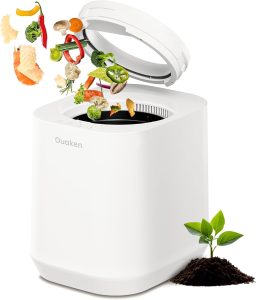
The Ouaken composter is a compact countertop unit built for daily food scraps in small to medium households.
Product Features
- 4 liter capacity, aluminum alloy body
- Three modes: Crush, Ferment, and Clean
- Runs below 40dB, quiet enough for nighttime use
- Carbon filter rated for up to 5 months of use
- Dishwasher safe detachable bucket
- Available in White or Black
What Buyers Like
Verified buyers highlight three things again and again in their reviews:
- Low noise. Many reviewers say they run it overnight without disturbance.
- Compact footprint. It fits on a standard counter without crowding other appliances.
- Odor control. The carbon filter keeps kitchen smells down, according to most reviews.
Why It Stands Out
Compared to larger composters, the Ouaken costs less upfront and takes up less counter space. The three-mode system also gives users control over speed versus compost quality, something cheaper single-mode units don’t offer.
Things to Know Before You Buy
- The manufacturer advises emptying the bucket fully between cycles. Leftover material can clump and strain the blades and fan.
- At 4 liters, this unit suits singles, couples, or small families more than large households.
- The carbon filter is a recurring cost every few months.
How to Clean It
The bucket is dishwasher safe, based on the product listing. The unit also includes a dedicated Clean mode for the internal chamber, which reviewers describe as simple to run between full composting cycles.
2. FoodCycler Eco 5 – Best for Large Households
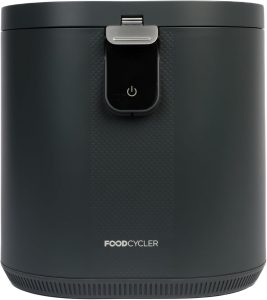
The FoodCycler Eco 5 is a larger, higher capacity option with an award winning design and a patented grinding system.
Product Features
- 5 liter capacity, the largest bucket in this comparison
- Vortech grinding system built to handle bones, pits, and peels
- Refillable carbon filter for odor control
- One touch button interface
- Removable bucket that can move around the kitchen
- Available in Gray or White
What Buyers Like
With a 4.6 star rating across 343 reviews and Amazon’s Choice status, this model draws strong praise for:
- Grinding power. Reviewers note it handles tougher scraps other machines struggle with, including bones and pits.
- Waste reduction. The listing states it can shrink food waste by close to 90 percent in a matter of hours.
- Portability of the bucket. Being able to move the removable bucket near food prep areas is a common favorite feature.
Why It Stands Out
The Vortech grinding system is the main differentiator here. Most countertop composters can’t process bones or hard pits without jamming. This one is built to handle them, based on manufacturer claims and buyer feedback.
Things to Know Before You Buy
- It’s the most expensive option on this list at $499.99.
- At 13.6 kg, it’s noticeably heavier than the other two picks, so plan for a fixed spot on your counter.
- The larger 5 liter capacity means it takes up more counter space than the Ouaken.
How to Clean It
The bucket is removable, which makes rinsing and wiping down easier between cycles. The carbon filter is refillable rather than fully replaceable, which can lower long-term running costs compared to filters you must swap out entirely.
3. Magic Mill Pro Food Dehydrator – Best for Jerky, Herbs, and Fruit
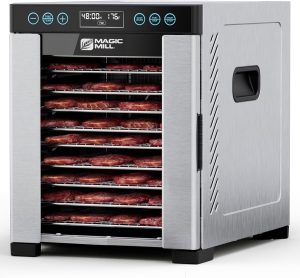
Unlike the two composters above, the Magic Mill Pro is a true dehydrator. It’s built for drying meat, fruit, herbs, and dog treats rather than turning scraps into compost.
Product Features
- 600 watt motor with a rear mounted fan for even air flow
- 10 stainless steel trays included, with fruit roll sheets
- Digital thermostat, countdown timer, and auto shut off
- Keep Warm function once the cycle ends
- Overheat protection built in
- ETL approved, BPA free stainless steel trays
What Buyers Like
With a 4.7 star rating and Amazon’s Choice status, buyers consistently mention:
- Even drying. The rear mounted fan means no need to rotate trays partway through, according to the listing and reviewer feedback.
- Tray flexibility. Mesh trays for small items like nuts and herbs, plus fruit leather sheets, cover a wide range of foods.
- Digital controls. The timer and auto shut off feature get frequent praise for convenience.
Why It Stands Out
This is the only true dehydrator on the list, meaning it’s better suited to making jerky, dried fruit, herbs, and dog treats rather than composting kitchen scraps. If your goal is food preservation rather than waste reduction, this is the more relevant tool.
Things to Know Before You Buy
- This is a dehydrator, not a composter. It does not turn food waste into fertilizer.
- Smaller and larger tray configurations are available at different price points if 10 trays is more or less than you need.
- All trays and liners are listed as dishwasher safe, which simplifies cleanup.
How to Clean It
The trays and liners are dishwasher safe per the manufacturer. The outer housing can be wiped down with a damp cloth, based on the product listing.
Composter vs. Dehydrator: Which Do You Need?
These three products solve different problems, so it helps to know which one fits your situation:
- Choose a composter (Ouaken or FoodCycler) if your goal is shrinking food waste and creating usable fertilizer for plants or gardens.
- Choose a dehydrator (Magic Mill) if your goal is preserving food, like making jerky, dried fruit, or herbs that last for months.
- Choose based on household size. Smaller households may prefer the compact 4 liter Ouaken. Larger households or those with tougher scraps like bones may prefer the 5 liter FoodCycler.
- Choose based on budget. The Magic Mill and Ouaken sit close in price, while the FoodCycler is the premium pick.
Buying Guide: What to Check Before You Purchase
Before picking any food waste dryer, composter, or dehydrator, check these five things:
- Capacity. Match the liter size or tray count to your household’s daily waste or drying needs.
- Noise level. If you plan to run it overnight, look for a unit under 45dB like the Ouaken.
- Filter type and cost. Refillable filters can save money over time compared to filters you replace entirely.
- Cleaning process. Dishwasher safe parts save time on upkeep.
- Safety certifications. Look for ETL approval and overheat protection, especially on dehydrators that run for many hours at a stretch.
Frequently Asked Questions
Is a food composter the same as a dehydrator?
No. A composter breaks down and dries food scraps into fertilizer. A dehydrator removes moisture from food like fruit or meat so it lasts longer without spoiling.
How much can these machines reduce food waste?
Manufacturer listings for both composters in this guide claim up to a 90 percent reduction in food waste volume after processing.
Do I need to empty the bucket between composting cycles?
Yes, based on the manufacturer guidance for the Ouaken. Leaving processed material in the bucket before starting a new cycle can cause clumping and strain the motor.
Are these machines noisy?
The Ouaken runs below 40dB, which most buyers describe as quiet enough for nighttime use. Noise levels for the FoodCycler and Magic Mill vary by cycle and load size.
Can the Magic Mill dehydrator handle bones or pits?
No. That feature belongs to the FoodCycler Eco 5, whose Vortech grinding system is built for tougher composting scraps. The Magic Mill is a dehydrator meant for drying, not grinding.
How often do I need to replace the carbon filter?
The Ouaken’s filter is rated for up to 5 months. The FoodCycler uses a refillable filter, which may lower ongoing costs.
Which is the best value pick overall?
Based on price and included features, the Magic Mill offers strong value for anyone focused on food preservation, while the Ouaken offers the lowest entry price for composting.