
Last Updated on June 22, 2026 by Kathay Lee
You want smooth soups, creamy sauces, or powerful smoothies. But you are standing in the kitchen aisle staring at two very different tools.
An immersion blender. A countertop blender.
Both blend food. But they work in completely different ways. Choosing the wrong one wastes money and counter space.
This guide breaks down every difference so you can pick the right blender for your kitchen.
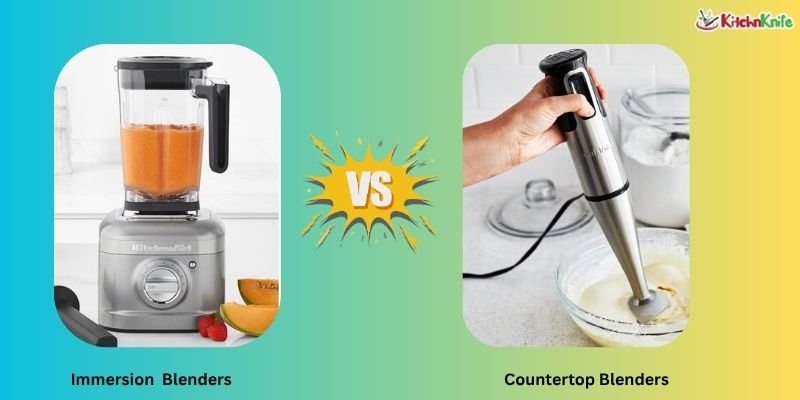
What Is an Immersion Blender?
An immersion blender is a handheld tool. You hold it and dip it directly into your pot, bowl, or cup.
It has a long stick with a spinning blade at the bottom. You control where it blends. It goes to the food, not the other way around.
Common names for this tool include stick blender, hand blender, and wand blender.
Popular brands include Braun, KitchenAid, and Cuisinart.
What Is a Countertop Blender?
A countertop blender sits on your counter. It has a motor base and a large jar or pitcher that locks on top.
You pour food into the jar, put the lid on, and press a button. The blade spins inside the container.
This is the classic blender most people picture. Vitamix, Ninja, and Blendtec make some of the most popular models.
Key Differences at a Glance
| Feature | Immersion Blender | Countertop Blender |
|---|---|---|
| Size | Compact, handheld | Large, sits on counter |
| Power | Low to medium | Medium to very high |
| Best For | Soups, sauces, small batches | Smoothies, large batches, ice |
| Cleanup | Very easy | Takes more effort |
| Price Range | $25 to $150 | $40 to $600+ |
| Storage | Drawer or cabinet | Counter space needed |
Power and Performance
Countertop blenders win on raw power.
A high-end countertop blender like a Vitamix 5200 runs at 1400 watts or more. It can crush ice, blend frozen fruit, and even make hot soup through friction alone.
An immersion blender usually runs between 200 and 800 watts. That is enough for soft ingredients, cooked vegetables, and baby food. But it struggles with hard ice, thick nut butters, or very fibrous foods.
If you need serious blending power, the countertop blender is the stronger tool.
Ease of Use and Cleanup
Here is where the immersion blender shines.
You blend right in the pot. No pouring hot liquid into a separate jar. No risk of a pressurized lid blowing off. No transferring food back and forth.
Cleanup is simple. Rinse the blade end under water or blend soapy water for a few seconds. Done.
A countertop blender needs more steps. You must wash the jar, lid, and blade assembly. Some parts are dishwasher safe, but it still takes more time.
For everyday cooking and quick tasks, the immersion blender saves real time.
Best Use Cases for Each
Use an immersion blender when you want to:
- Blend soup directly in the pot
- Make a quick sauce or puree
- Whip cream or froth milk
- Prepare baby food
- Mix salad dressings or marinades
- Blend small portions
Use a countertop blender when you want to:
- Make thick smoothies with frozen fruit
- Crush ice for cocktails or slushies
- Blend large batches at once
- Make nut butters or protein shakes
- Achieve ultra-smooth, silky textures
- Process hard or fibrous ingredients
Which One Should You Choose?
Ask yourself one question first: what do you cook most often?
If you make soups, sauces, and small batches regularly, an immersion blender fits your life better. It is fast, convenient, and easy to store.
If you make smoothies every morning, meal prep in bulk, or blend tough ingredients like frozen berries, seeds, or ice, a countertop blender gives you the power you need.
Many home cooks actually own both. An immersion blender handles daily tasks. A countertop blender handles heavier jobs on weekends or meal prep days.
If budget or space is a concern, start with the one that matches your most common cooking habit.
Final Verdict
Both blenders are useful. Neither is better in every situation.
The immersion blender is the winner for convenience, cleanup, and everyday cooking.
The countertop blender is the winner for power, volume, and heavy-duty blending tasks.
Match the tool to what you actually cook. That is the smartest choice you can make.