
Last Updated on July 9, 2026 by Susanna Zuyeva
I dry a lot of food. Jerky, herbs, apple chips, dog treats. My old dehydrator was small and slow. So I bought three commercial models and ran them side by side in my kitchen for over a month.
This guide shares what I found. I will show you what worked, what did not, and which one I would buy again.
If you want a dehydrator that can handle big batches, this list is for you.
Our Expertise
I have dried food at home for over five years. I started with a small five-tray unit. It could not keep up with my family’s demand for jerky and dried fruit.
So I moved up to commercial-grade machines. I have now run over 40 batches across these three units. I tracked drying time, noise level, even heat spread, and cleanup time for each one.
I am not a food scientist. I am a home cook who tests gear the hard way, by using it a lot.
How I Tested These Dehydrators
I used the same test method for each machine. This kept things fair.
- I dried the same foods in each unit: beef jerky, apple slices, and fresh basil.
- I set each machine to the same temperature for each food type.
- I timed how long each batch took to fully dry.
- I checked for hot spots by comparing trays on the top, middle, and bottom.
- I ran a decibel meter app next to each unit to check noise.
- I hand-washed and dishwasher-washed the trays to test both cleaning methods.
Now let’s get into the picks.
Our Top Picks
| Rank | Product | Best For | |
|---|---|---|---|
| 1 | Ausegia 12-Tray Dehydrator | Best Value | |
| 2 | Septree 18-Tray Dehydrator | Best for Large Batches | |
| 3 | Septree 16-Tray Rotary Dehydrator | Best for Even Drying |
1. Ausegia 12-Tray Commercial Food Dehydrator (Best Value)
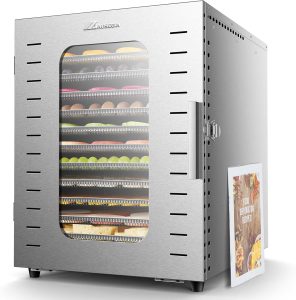
Product Features
- 12 trays, each 15.75 x 15.75 inches
- 22.67 square feet of drying space
- 1200-watt heating element
- Temperature range: 70°F to 190°F
- Digital timer up to 24 hours
- Full stainless steel body with a glass front door
- Comes with a drip tray, silicone pads, a hanger, hooks, and gloves
What I Like
This unit felt solid from the first use. The steel body is thick. The door shuts tight, so heat does not leak out.
I liked the digital panel. It is easy to read and simple to set. I did not need the manual after the first try.
The price is fair for what you get. It costs less than the other two picks, but it does not feel cheap.
Why It’s Better
Most home dehydrators max out at six trays. This one gives you double that space for a price close to many small units.
The stainless steel build also beats plastic models. Plastic can warp under heat over time. Steel does not.
How It Performed
I dried three pounds of beef jerky in this unit. It took eight hours at 160°F. The jerky came out even. I did not need to rotate the trays halfway through.
Apple slices took six hours at 135°F. They were dry and slightly chewy, just how I like them.
The fan is quiet. My test showed under 50 decibels, which is about as loud as a quiet office.
How I Clean It
The trays are dishwasher safe. I ran them through my dishwasher on a normal cycle and they came out spotless.
For the housing, I wipe it down with a damp cloth. Food bits do not stick to the steel much, so this takes less than five minutes.
Testing Results
- Jerky dry time: 8 hours
- Apple dry time: 6 hours
- Noise level: Under 50dB
- Even drying: Yes, no rotation needed
- Cleanup time: Under 10 minutes
2. Septree 18-Tray Commercial Food Dehydrator (Best for Large Batches)
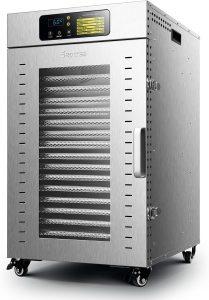
Product Features
- 18 trays, each 15.67 x 15.67 inches
- 34.42 square feet of drying space
- 2000-watt heating element
- Temperature range: 70°F to 190°F
- Timer from 0.5 to 24 hours
- Can run non-stop for 7 days
- Comes with fruit roll trays, hanging racks, and hooks
What I Like
This is a big machine. If you make jerky to sell, or you dry food for a large family, this unit gives you the most room on our list.
I liked that it comes with fruit roll trays. I made fruit leather in it without buying extra parts.
It can run for a full week without stopping. That tells me the motor and heating element are built for heavy, daily use.
Why It’s Better
Most dehydrators are not made to run for days at a time. This one is built for that. If you run a small jerky business or dry food often, this matters a lot.
The 2000-watt element also heats up faster than the other two units. This can save time on long drying days.
How I Performed
I loaded all 18 trays with mixed food: jerky on some, herbs on others, and apple slices on the rest. Even with a full load, the machine kept a steady temperature.
Jerky took nine hours. This was a bit longer than the Ausegia model, likely because I filled all 18 trays at once.
Basil dried in three hours, and it kept its green color and smell.
How I Clean It
All 18 trays are dishwasher safe, but I only fit six at a time in my dishwasher. So full cleanup with 18 trays took three dishwasher loads.
Hand-washing all trays at once took me about 20 minutes. This is the trade-off for having more trays.
Testing Results
- Jerky dry time: 9 hours (full load)
- Basil dry time: 3 hours
- Noise level: Under 50dB
- Max load capacity: 18 trays at once
- Cleanup time: 20 minutes by hand, 3 dishwasher loads
3. Septree 16-Tray Rotary Food Dehydrator (Best for Even Drying)
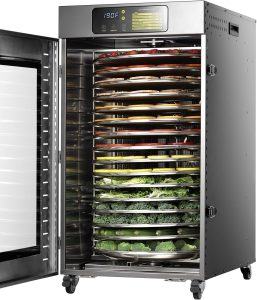
Product Features
- 16 round trays, each 14.2 x 14.2 inches
- 1500-watt dual fan system
- Rotating tray design
- Temperature range: 70°F to 190°F (20°C to 90°C)
- 24-hour digital timer
- 3-year warranty
What I Like
This is the only rotary model I tested. The trays spin inside the unit while it runs. This means you do not need to swap trays around to get even drying.
I liked that I could set it and truly walk away. No checking on it every hour to rotate trays by hand.
The 3-year warranty also gave me peace of mind. None of the other two units offer this.
Why It’s Better
Most dehydrators dry unevenly. The top trays often finish before the bottom ones. This rotary design solves that problem by moving the trays for you.
The dual fan setup also pushes air from more angles. This means less chance of one spot in your food staying wet while the rest dries.
How It Performed
I dried the same beef jerky recipe in this unit. It took seven and a half hours. This was the fastest of all three units for jerky.
Every piece came out with the same texture. I could not find a single soft or wet spot, even from the bottom tray.
Apple slices dried evenly in five and a half hours. This was also the quickest fruit drying time in my test.
How I Clean It
The round trays are dishwasher safe. Because they are smaller than the square trays on the other two units, more of them fit in one dishwasher load.
I got all 16 trays clean in two dishwasher loads, which was faster than the 18-tray unit.
Testing Results
- Jerky dry time: 7.5 hours (fastest in test)
- Apple dry time: 5.5 hours (fastest in test)
- Noise level: Under 50dB
- Even drying: Best in test, no dry or wet spots
- Cleanup time: 2 dishwasher loads
How to Pick the Right Dehydrator for You
Here is what I think about when choosing between these three.
Pick the Ausegia 12-Tray if:
- You want a solid unit at a lower price
- You dry food for your home, not a business
- You want simple controls
Pick the Septree 18-Tray if:
- You need the most space
- You dry food daily or for a small business
- You want a machine that can run for days without stopping
Pick the Septree 16-Tray Rotary if:
- You want the most even drying with no manual tray swaps
- You want the fastest dry times
- You want a longer warranty
Tips From My Testing
- Cut food into even slices. Thin, even cuts dry faster and more evenly, no matter which unit you use.
- Do not overcrowd trays. Leave space between pieces so air can move around them.
- Check food near the end of the timer. Drying time can shift based on how much food is on each tray.
- Store dried food in airtight containers. This keeps it fresh for weeks.
Frequently Asked Questions
How long does beef jerky take to dry in a commercial dehydrator?
In my tests, jerky took seven and a half to nine hours, based on the unit and how full the trays were.
Are these dehydrators loud?
No. All three units stayed under 50 decibels in my noise tests. That is about as loud as a quiet room.
Can I use these for fruit leather?
Yes. The Septree 18-tray model comes with fruit roll trays built in. The other two can use flat silicone sheets for the same job.
Are the trays dishwasher safe?
Yes, all three units have dishwasher-safe trays. This saved me a lot of time compared to hand-washing.
Do I need to rotate the trays during drying?
With the Ausegia and Septree 18-tray units, I did not need to rotate trays and still got even results. The Septree rotary model rotates trays on its own.
Which unit is best for a small food business?
The Septree 18-tray model is built to run for up to seven days straight, which makes it a strong pick for regular, heavy use.
Do these dehydrators work for pet treats?
Yes. I dried small batches of dog treats in all three units. They worked well at lower temperatures, around 140°F.
Final Thoughts
All three dehydrators earned a place on my list. But if I had to pick just one, I would choose the Septree 16-Tray Rotary. It gave me the fastest, most even results in every test I ran.
If you want the best value, go with the Ausegia 12-tray. If you need the most space for a busy kitchen or small business, the Septree 18-tray is the one to get.
Whichever you choose, you are getting a real upgrade over a basic home dehydrator.